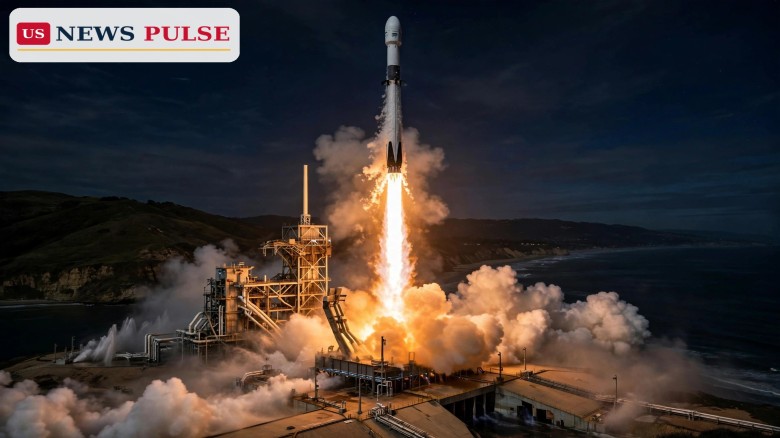
SpaceX has flown its Falcon 9 rocket for the 700th time, closing out October 2026 with a Halloween-eve Starlink launch from California that also underlined how the most-flown rocket in history is slowly handing over to Starship. The Falcon 9 700th launch carried 27 Starlink internet satellites into low Earth orbit and ended, as so many Falcon flights now do, with a booster standing upright on a droneship in the Pacific.
The Starlink 15-18 mission lifted off from Space Launch Complex 4 East at Vandenberg Space Force Base at 9:04 p.m. Pacific time on Friday, October 30, 2026, which was 12:04 a.m. Eastern and 0404 UTC on Saturday, October 31. The rocket flew on a southeasterly trajectory from the California coast, and the 27 satellites were headed for deployment roughly an hour after launch, according to SpaceX's mission timeline as reported in launch coverage.
SpaceX used first-stage booster B1093 for the flight. It was the booster's 18th trip to space, following the Transporter-16 rideshare mission, two missions for the Space Development Agency and 14 previous batches of Starlink satellites. About eight and a half minutes after liftoff, B1093 touched down on the droneship Of Course I Still Love You, stationed in the Pacific Ocean. Spaceflight Now recorded it as the 231st landing on that vessel and the 675th Falcon booster landing overall, a tally that captures just how routine reusability has become for SpaceX.
The mission closed SpaceX's October manifest. It was the company's 11th and final orbital flight of the month, a total that still far exceeds what any other launch provider manages in a month, even as SpaceX's own pace cools from its peak. The October count included three launches from Cape Canaveral Space Force Station, one from Kennedy Space Center and the rest from Vandenberg, reflecting a year in which California has carried more of the Falcon workload than Florida.
Falcon 9 has come a long way from its debut in 2010. The rocket's first successful landing of an orbital-class booster, in December 2015, turned reusability from an experiment into the backbone of SpaceX's business, and the booster fleet has since been pushed to ever-higher reuse counts. The fleet record stands at 37 flights, set this past August by booster B1067, according to launch trackers. Against that background, B1093's 18th flight looks almost ordinary, which is itself a measure of how far the programme has travelled.
California's role in that story has grown sharply in 2026. Just days before this milestone, on October 27, a Falcon 9 carrying the Starlink 15-16 mission lifted off from the same Vandenberg pad and marked California's 72nd launch of the year, breaking the state's previous annual record and putting it ahead of Florida for the first time since the 1970s. SpaceX stopped flying Falcon 9 Starlink missions from Florida in August, and the Sunshine State's remaining 2026 Falcon flights have been a smaller set of missions including NASA's Crew-13, the CRS-35 cargo flight and Bandwagon-5.
The satellites themselves are Starlink V2 Mini Optimized spacecraft, the current workhorse version of a constellation that tracking counts cited in coverage put at nearly 10,000 operational satellites. Each Starlink batch adds capacity to a network that now serves as one of SpaceX's largest sources of revenue, and one that increasingly shapes the company's launch priorities.
The 700th flight arrives at an awkward but telling moment for Falcon 9. SpaceX is openly winding the rocket down as it shifts engineering attention and launch capacity to Starship, the far larger vehicle designed to be fully and rapidly reusable. NASA and others have publicly acknowledged that SpaceX intends to stop offering Falcon 9 for commercial and government missions in the next few years, and the company's falling launch rate reflects that change.
The numbers tell the story. On October 27, SpaceX's rolling 365-day total dropped below 150 orbital launches for the first time since July 2025, down from a peak of 171 in December 2025. Monthly totals across 2026 ran at 13, 12, 15, 12, 11, 13, 13, 13 and 8 launches from January through September, before October's 11. That is still an extraordinary cadence by any historical standard, but the direction of travel is now unmistakably downward for Falcon, and upward for its successor.
SpaceX founder Elon Musk set out the Starship timetable on the company's third-quarter earnings call earlier in October, and launch watchers have treated it as the clearest guide to what comes next. "We expect Starship to fly weekly at some point in the first half next year and then second half next year, twice weekly or maybe even more frequently by the end of next year," Musk said. "The rate at which we launch Starship will increase dramatically as we solve rapid and complete reusability."
Musk also confirmed that the next Starship flight will attempt something no previous flight has tried: catching the vehicle's upper stage. That mission, Starship Flight 15, is expected in mid-November from Starbase in Texas, and it will be watched closely as a test of whether the giant rocket can match Falcon's reusability in full.
Launch analysts, meanwhile, have noted the quiet significance of the milestone itself. Falcon 9 reaching 700 flights without a change of basic design is, in their telling, the payoff of a reusability bet that much of the industry once dismissed. No rival rocket family has come close to that flight count in the reusable era, and the booster-landing tally, now 675, is the statistic that explains why SpaceX can still launch at a pace others cannot match even while winding the programme down.
The Falcon 9 700th launch matters for three reasons. First, it confirms that reusability works at scale: a single rocket design, flown 700 times with boosters reused again and again, has carried crews, cargo, science missions and thousands of satellites. Second, it marks the moment when that era begins to close, with Starship expected to start regular orbital missions in 2027 and to take over the heavy lifting for both commercial customers and NASA's Moon plans. Third, it shows where SpaceX's business is heading, with connectivity and computing capacity now driving launch demand as much as traditional satellite orders.
For the wider space industry, the milestone is also a challenge. Competitors have spent years trying to match Falcon's cost and cadence, and most are still working toward their first reusable booster recovery. By the time they get there, SpaceX intends to be flying a much larger, fully reusable vehicle several times a week. The gap Falcon opened may simply be carried forward by Starship.
SpaceX's launch list still shows Falcon 9 missions ahead, including USSF-432 from California, currently shown for the evening of November 2 Eastern time, though launch dates can move and should be treated as targets rather than promises. Starship Flight 15, with its planned upper-stage catch attempt, is the next big date on the calendar, expected in mid-November from Starbase.
Beyond that, the transition will be gradual rather than sudden. Falcon 9 will keep flying contracted missions, including crew and cargo flights to the International Space Station, while Starship builds flight rate. But the 700th launch will likely be remembered as the high-water mark of the Falcon era: the night the workhorse hit a round number, landed its booster one more time, and quietly began its long goodbye.
It was the Starlink 15-18 mission, which lifted off from Vandenberg Space Force Base in California on October 30, 2026, carrying 27 Starlink satellites. It was the 700th launch of a Falcon 9 rocket to date.
Booster B1093, flying for the 18th time. It landed on the droneship Of Course I Still Love You about eight and a half minutes after liftoff, marking the 675th Falcon booster landing overall.
Twenty-seven Starlink V2 Mini Optimized satellites, bound for low Earth orbit to join a constellation that tracking counts put at nearly 10,000 operational spacecraft.
Not immediately. SpaceX is winding the programme down over the next few years as Starship ramps up, with regular orbital Starship missions expected from 2027, but Falcon 9 will keep flying contracted missions in the meantime.
Starship Flight 15 from Starbase in Texas, expected in mid-November, which aims to attempt a catch of the Starship upper stage for the first time.
Related coverage on US News Pulse: California rocket launch record: SpaceX passes Florida with 72nd launch, SpaceX NASA Moon landing at risk as Starlink and AI take priority, reports say, and NASA Swift Observatory ends 22-year mission as spacecraft falls back to Earth.
Leave a Comment



 | Today's Date: