


 | Today's Date:




China Blocks SoftBank's $5.4 Billion ABB Robotics Deal in Blow to Son's AI Push
China has blocked SoftBank's $5.4 billion takeover of ABB's robotics division, dealing a sharp blow to Masayoshi Son's plan to put the Japanese investment group at the centre of the artificial intelligence age. The decision, reported on Thursday, November 5, 2026, turns one of the year's biggest industrial deals into a test of how far Beijing will go to keep robotics data inside China.
China's National Development and Reform Commission told SoftBank it would not allow the acquisition to go ahead, the Financial Times reported, citing several people familiar with the matter. ABB confirmed on Thursday that Chinese regulators had blocked the deal, while insisting that talks with SoftBank continue.
Key Points
- China's National Development and Reform Commission told SoftBank it will not allow its $5.4 billion acquisition of ABB's robotics division to proceed.
- ABB confirmed on Thursday, November 5, 2026, that Chinese regulators blocked the deal, and said it is in close dialogue with SoftBank.
- Beijing fears robotics data generated in China could be transferred overseas and used to train AI models, including OpenAI's.
- SoftBank agreed in October 2025 to buy 100 percent of ABB's robotics business for about $5.375 billion; the division employs more than 7,000 people.
- SoftBank shares fell about 5.5 percent in Tokyo on Thursday, and the company is assessing whether it can reapply.
What Happened
The Financial Times reported on Thursday that the National Development and Reform Commission, China's top economic planning body, had told SoftBank the $5.4 billion acquisition would not be allowed to go ahead, citing multiple people familiar with the matter. Later the same day, ABB confirmed that Chinese regulators had blocked the acquisition of its robotics business in China. The Swiss group said it is in close dialogue with SoftBank and that the two companies are working constructively on the transaction. Neither side said the deal was dead.
The timing is awkward for both companies. SoftBank agreed in October 2025 to buy the whole of ABB's robotics business for about $5.375 billion. The deal had already won unconditional approval from the European Union in March 2026, while US approval was still pending. Completion had been planned for mid-to-late 2026.
Background and Context
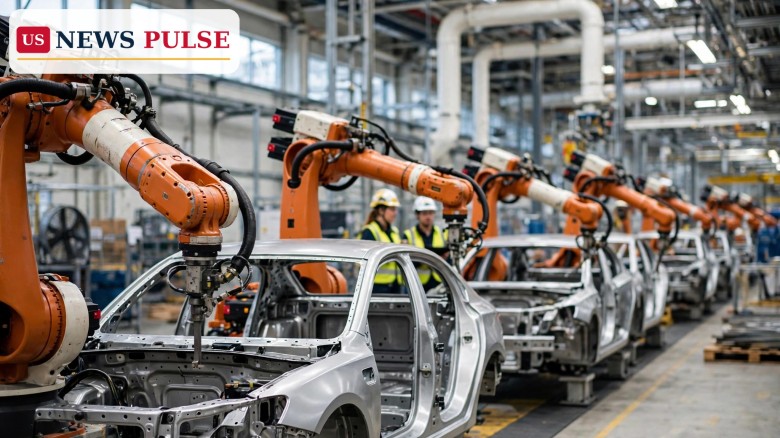
ABB's robotics division builds industrial robots that weld, paint, assemble and move parts in factories around the world. Its customers include carmakers such as BMW. The division employs more than 7,000 people and is one of the largest robotics businesses in the world. For ABB, the sale was part of a long shift towards software and electrification.
For SoftBank, it was the centrepiece of Masayoshi Son's push into physical AI: robots powered by advanced artificial intelligence models, working in factories and warehouses. SoftBank is a major investor in OpenAI, the maker of ChatGPT, and has poured billions into AI infrastructure, chips and data centres. Buying ABB's robotics arm would have given SoftBank the machines to match the models.
Why China Blocked the SoftBank ABB Robotics Deal
The core concern, according to the Financial Times, is data. The National Development and Reform Commission was worried that robotics data generated in China could be transferred overseas and used to train AI models, including those developed by OpenAI. Industrial robots generate vast amounts of operational data: how parts are handled, how production lines are tuned, how factories respond to faults. In Beijing's view, that data is a strategic asset.
The decision fits a wider pattern. China has spent the past year tightening control over data, technology and foreign investment in sensitive sectors. It is also the second major deal Beijing has blocked this year, after Meta was ordered to unwind its acquisition of AI startup Manus, valued at more than $2 billion.
Reactions and Quotes
ABB confirmed the block in a statement on Thursday, saying Chinese regulators had stopped the acquisition of its robotics business in China. The company stressed that it remains in close dialogue with SoftBank and that the two companies are working constructively on the transaction.
SoftBank has not announced a new plan. It is assessing what went wrong and whether it can reapply, a process that could take months. Investors reacted swiftly: SoftBank shares fell about 5.5 percent in Tokyo on Thursday, wiping billions of dollars from the company's market value in a single session.
Why It Matters
First, the block shows that data is now as important as ownership in cross-border deals. Regulators are no longer asking only who buys a company. They are asking where its data goes, who trains models on it, and whether that knowledge leaves the country.
Second, it complicates SoftBank's AI strategy. Son's plan depends on combining capital, computing power and physical machines. Without ABB's robotics division, SoftBank must find another robot maker, build its own, or accept a slower path into the sector.
Third, it sends a signal to every other buyer and seller. If China can block a $5.4 billion deal between a Japanese buyer and a Swiss seller over data generated in Chinese factories, any global robotics or AI deal with a Chinese footprint faces the same risk.
What Happens Next
Three paths are open. SoftBank could reapply with a revised structure, perhaps by ring-fencing Chinese data or keeping the Chinese robotics business under separate ownership. ABB could seek another buyer, though few could match SoftBank's price. Or the sale could be abandoned, leaving ABB to keep a business it had planned to exit. US approval is still pending, but it now matters less: even with American clearance, the deal cannot close without China.
Frequently Asked Questions
Why did China block SoftBank's purchase of ABB's robotics division?
China's National Development and Reform Commission feared robotics data generated in China could be transferred overseas and used to train AI models, including OpenAI's.
How much was the deal worth?
SoftBank agreed in October 2025 to buy 100 percent of ABB's robotics business for about $5.375 billion. The division employs more than 7,000 people.
Is the deal completely dead?
Not yet. ABB said it is in close dialogue with SoftBank, and the two companies are working constructively on the transaction. SoftBank is assessing whether it can reapply.
What other approvals did the deal have?
It won unconditional approval from the European Union in March 2026. US approval was still pending, and completion had been planned for mid-to-late 2026.
Has China blocked other deals this year?
Yes. It is the second major deal blocked by China this year, after Meta was ordered to unwind its acquisition of AI startup Manus, valued at more than $2 billion.
Read more on US News Pulse: China Speeds Up Full-Lifecycle AI Law Covering DeepSeek, Alibaba and Moonshot, OpenAI Security Warnings: Staff Raised Alarm for Years, Reuters Reports, and AMD Takes $1.07 Billion Charge as OpenAI and Meta Chip Warrants Begin to Bite.
Leave a Comment