


 | Today's Date:




Bank of England Raises Rates to 4% in First Hike Since 2023 as War Fuels Inflation
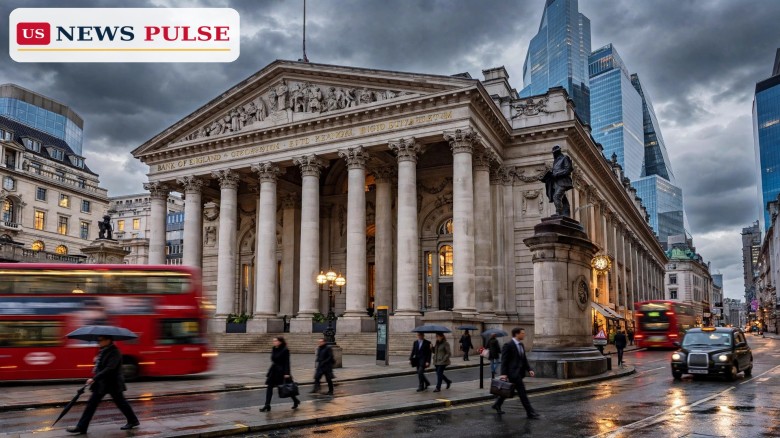
The Bank of England raised interest rates to 4% on Thursday, its first increase in more than three years, as the war between the United States and Iran pushes energy prices higher and drives British inflation towards 5%. The quarter-point rise takes Bank Rate to its highest level since early 2023. Governor Andrew Bailey stressed it should not be read as the start of an inevitable run of increases, but warned further rises cannot be ruled out while the conflict continues.
Key Points
- The Bank of England raised Bank Rate by 25 basis points to 4% on Thursday, November 5, 2026, its first rate rise since August 2023.
- The Monetary Policy Committee voted 8-1 for the increase; external member Catherine Mann dissented, arguing for a half-point rise to 4.25%.
- UK inflation, 3.5% in September, is forecast to reach around 5% in mid-2027, peaking at 4.8% in the second quarter.
- The Bank does not expect inflation to return to its 2% target until the third quarter of 2028.
- Growth forecasts rose to 1.6% for 2026 and 1.3% for 2027, but real household income from work is set to fall this year and next.
What Happened
The Bank of England's Monetary Policy Committee voted 8-1 to lift Bank Rate from 3.75% to 4%, the first increase since August 2023 and the first since the US-Iran war began in late February 2026. The decision was widely expected after weeks of warnings that the energy shock from the eight-month war was feeding into prices faster than expected.
Catherine Mann, one of the committee's external members, dissented in favour of a half-point rise to 4.25% to get ahead of the inflationary pressure. Her dissent underlines the scale of the challenge: inflation has proved stickier than hoped, and the war has added a fresh shock on top of already-elevated prices.
Governor Andrew Bailey framed the decision as a response to a specific shock rather than the start of a new tightening cycle. He said the rise should not be seen as the first in an inevitable long sequence of hikes, but added a clear warning: "unless the conflict in the Middle East is resolved, neither does it seem likely to be the last increase."
Background and Context
The Bank spent the three years after August 2023 gradually cutting rates as the post-pandemic inflation surge faded. By early 2026, Bank Rate had fallen to 3.75%, and many economists expected further cuts. The outbreak of the US-Iran war in late February changed that calculation entirely.
The conflict has disrupted energy supplies and pushed oil and gas prices sharply higher. Brent crude, near $105 a barrel in early November, has been volatile throughout the war, and the Bank now assumes energy costs will keep feeding into consumer prices through 2027. The same pressures have forced other major central banks to act: the Federal Reserve and the European Central Bank have also raised rates in recent months.
Raising rates into a weak economy is painful, but the Bank's mandate is clear: keep inflation at 2%, and inflation heading towards 5% left it little room to stand still.
Bank of England Rate Rise: What It Means for Households
For households, the rate rise will be felt quickly in some places and slowly in others. Borrowers on variable-rate mortgages will see their monthly payments increase within weeks, while those on fixed-rate deals are protected until their current deal expires. With millions of fixed-rate mortgages due for renewal over the coming year, many families will face higher payments.
Savers should see slightly better returns, although banks are often slow to pass on rate rises to depositors. Credit card and personal loan rates are also likely to edge up. The Bank's warning that real household income from work is set to fall this year and next is the more sobering part of the outlook: wages are not keeping pace with prices, and higher borrowing costs plus falling real incomes will squeeze family budgets.
Reactions and Quotes
Governor Andrew Bailey's central message was one of caution rather than commitment. He said the rise should not be seen as the first in an inevitable long sequence of hikes, but added that "unless the conflict in the Middle East is resolved, neither does it seem likely to be the last increase." The wording leaves the Bank room to pause if the war eases, while keeping markets in no doubt that more rises are possible.
Mann's dissent for a half-point rise signals that at least one member believes the Bank should move faster. Markets took the decision in their stride, having priced in a quarter-point rise. No fresh quotes from the Chancellor or business groups were carried in the Bank's announcement.
Why It Matters
The decision matters far beyond Threadneedle Street. It is the clearest sign yet that the US-Iran war is reshaping economic policy across the developed world, forcing central banks that had been cutting rates to reverse course. The Federal Reserve and the European Central Bank have already moved in the same direction, and the Bank's action confirms that energy-driven inflation is now a shared global problem.
For the UK, the rise ends a three-year era of falling borrowing costs. The Bank's forecast that inflation will not return to 2% until the third quarter of 2028 means the squeeze on living standards will continue for years, not months.
What Happens Next
The Bank's next decision will depend heavily on events in the Middle East. If the war eases and energy prices fall, the Bank could pause and assess the November rise. If the conflict escalates or drags on, further increases are likely, as Bailey acknowledged.
Economists will also watch the Bank's next inflation report. If inflation peaks lower than the projected 4.8% in the second quarter of 2027, pressure for further rises may ease. Mortgage lenders are expected to reprice deals in the coming days, and households coming off fixed-rate deals should check their new payments.
Frequently Asked Questions
What is the new Bank of England interest rate?
Bank Rate is now 4%, up from 3.75%, after a 25-basis-point rise announced on Thursday, November 5, 2026.
When was the last Bank of England rate rise before this one?
The previous increase was in August 2023. The Bank spent the following three years cutting rates before Thursday's decision.
Why did the Bank of England raise rates?
The US-Iran war has pushed energy prices higher, driving UK inflation towards 5%. The Bank expects inflation to peak at an average of 4.8% in the second quarter of 2027.
How will the rate rise affect my mortgage?
Variable-rate borrowers will see payments rise quickly. Fixed-rate borrowers are unaffected until their deal ends, when they may face higher rates on renewal.
Will the Bank of England raise rates again?
Bailey said the rise should not be seen as the start of an inevitable sequence, but warned further rises are likely unless the conflict in the Middle East is resolved.
Related coverage: Novo Nordisk lifts 2026 outlook as Wegovy pill sales hit $810 million; David Jones, Australia's 188-year-old department store, enters administration; Rheinmetall shares plunge 17% after second guidance cut.
Leave a Comment