


 | Today's Date:





Second US Carrier USS Gerald R. Ford Heads to Middle East as Iran Decision Nears
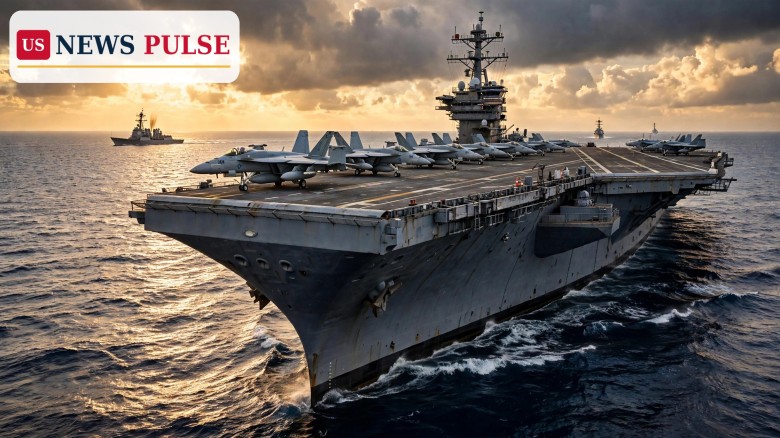
The United States is sending a second aircraft carrier strike group toward the Middle East, sharply increasing the military pressure on Iran as President Donald Trump weighs whether to reach a negotiated settlement or widen a war now in its ninth month. The USS Gerald R. Ford, the world's largest aircraft carrier, is sailing east with four destroyers, a US official told ABC News, in a move first reported by The New York Times.
The Ford will join the USS Abraham Lincoln, which arrived in the region late last month, giving the United States two carrier strike groups within striking distance of Iran. The deployment comes as US and Iranian representatives met in Geneva this week for talks on Tehran's nuclear programme — and as Trump said the world would learn his decision “over the next, likely, 10 days.”
Key Points
- The USS Gerald R. Ford, the world's largest aircraft carrier, is heading to the Middle East with four destroyers, a US official told ABC News.
- The Ford will join the USS Abraham Lincoln, giving the US two carrier strike groups near Iran for the first time in the current conflict.
- Trump said on Thursday he would “rather not destroy the rest” of Iran but “maybe I'll have to,” with a decision coming soon.
- US and Iranian representatives met in Geneva this week for talks on Tehran's nuclear programme, with no deal announced.
- The Ford had been operating in the Caribbean and took part in operations in Venezuela earlier this year; the move extends its already long deployment.
What Happened
The Ford briefly transmitted its location off the coast of Morocco on Wednesday, November 4, as it approached the Mediterranean, according to MarineTraffic data. Two C-2A Greyhound aircraft operating off the carrier were also visible on FlightRadar24 the same day, offering a rare public glimpse of the strike group's eastward course.
Three of the four destroyers sailing with the Ford have accompanied it since it first deployed in June. The fourth previously served in the Caribbean force surge, a sign that the Pentagon is pulling ships from other missions to reinforce the Middle East buildup. The Ford is the lead ship of the Navy's newest class of carriers and the largest warship ever built.
Background: Nine Months of War and a Stalled Deal
The US-Iran war began on February 28, 2026, and is now in its ninth month. The United States has struck Iranian targets repeatedly, including defensive strikes on Qeshm Island this week, while Iran has kept up pressure in the Gulf, where tanker attacks have continued at a near-record pace and mines have damaged vessels in the Strait of Hormuz.
Diplomacy has run alongside the fighting. Qatari mediators have shuttled between the sides, and the Geneva meeting this week was the latest attempt to find terms for a settlement. Iran has sent Washington a nuclear proposal through Qatar, conditional on seven demands, while the US has insisted on a firm, verifiable commitment that Tehran will not rebuild its nuclear programme, which Washington says it destroyed.
USS Gerald R. Ford: The Navy's Largest Carrier Joins the Buildup
The arrival of the Ford would double the carrier airpower the US has positioned near Iran. A single carrier strike group typically carries dozens of fighter jets, surveillance aircraft and helicopters, plus destroyers armed with cruise missiles and missile-defence systems. Two groups can sustain round-the-clock air operations and defend each other while keeping pressure on an adversary.
The redeployment also underlines how stretched the Navy has become. The Ford had been operating in the Caribbean and took part in operations in Venezuela earlier this year, and its deployment was already lengthy before the new orders. Moving it to the Middle East leaves fewer major warships for other regions, a trade-off the Pentagon has accepted as the Iran decision approaches.
Reactions and Quotes
Trump said this week that he was considering sending a second carrier if no deal is reached with Iran. On Thursday, November 5, he told reporters he would “rather not destroy the rest” of Iran but “maybe I'll have to,” adding that a decision was coming soon and the world would find out “over the next, likely, 10 days.”
Vice President JD Vance said on Monday that Washington had made “progress” in talks with Iran and that the US had set “no strict deadline” for a deal before strikes resume. US envoy Steve Witkoff said in a Fox News interview that Trump is “curious” why Iran has not capitulated given the US show of force, with the Ford now moving toward the region.
Why It Matters
Two carrier strike groups give Trump both a stronger hand at the negotiating table and a far more capable force if he chooses to strike. The buildup signals to Tehran that the threat of renewed attacks is real, while also raising the stakes of any miscalculation: with more warships, aircraft and troops concentrated in a narrow stretch of water, a single incident — a mine strike, a drone attack or a clash in the Strait of Hormuz — could escalate quickly. Oil markets are already reacting, with prices rebounding this week as tanker attacks kept fears of a supply disruption alive.
What Happens Next
The Ford is expected to transit the Mediterranean and reach the region in the coming days, while the Geneva talks continue and Qatari mediators review suggestions from both sides. Trump has said his decision will come within about 10 days, and Trump warned he may have to destroy the rest of Iran if no agreement is reached. All eyes will also be on the Strait of Hormuz, where Iran sent the US a nuclear proposal through Qatar, and on whether a third carrier — the USS Theodore Roosevelt, already ordered toward the region — follows the Ford.
Frequently Asked Questions
Why is the US sending a second aircraft carrier to the Middle East?
To increase military pressure on Iran while nuclear talks continue, and to have a far stronger force ready if President Trump decides to widen the war.
Which carriers are now near Iran?
The USS Abraham Lincoln, which arrived late last month, and the USS Gerald R. Ford, which is sailing to join it. The USS Theodore Roosevelt has also been ordered toward the region.
How many ships are sailing with the Ford?
Four destroyers — three from its own carrier strike group and a fourth previously part of the Caribbean force surge.
When will Trump decide on Iran?
Trump said on Thursday, November 5, that the world would find out “over the next, likely, 10 days.”
Are the US and Iran still talking?
Yes. Representatives of both countries met in Geneva, Switzerland, this week for talks on Iran's nuclear programme, with Qatari mediators involved.
Leave a Comment