
US Staff Leave Saudi Arabia After Houthi Airport Attacks, Embassy Warns
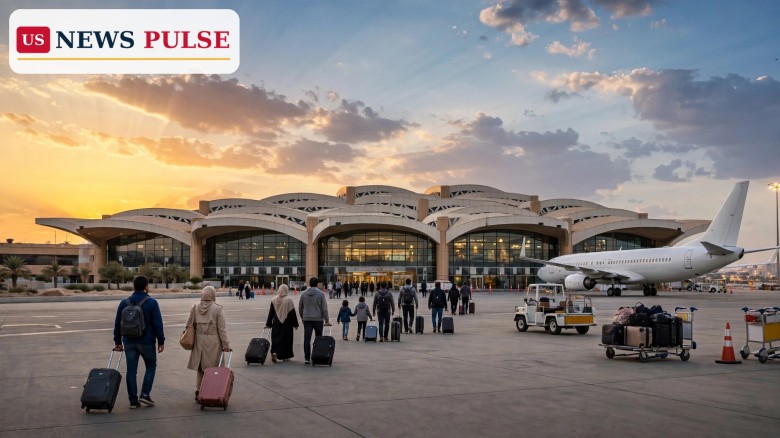
The United States has ordered its non-emergency government employees and their family members to leave Saudi Arabia, after a wave of Houthi attacks on civilian airports and other critical infrastructure raised fears of further strikes, airspace closures and severe travel disruption. The order, effective October 23, 2026, was set out in a countrywide security alert issued by the US Mission to Saudi Arabia on October 30, and reported by Reuters the same day, as fighting between Yemen's Iran-aligned Houthis and the Saudi-led coalition intensified and the wider US confrontation with Iran deepened.
Key Points
- The State Department ordered non-emergency US government staff and their families to leave Saudi Arabia, effective October 23, 2026.
- The US Mission blames Iranian-supported Houthi attacks on civilian airports and critical infrastructure, which it says caused civilian casualties and severe travel disruption.
- US government employees still in the kingdom now need special authorisation from the Chief of Mission to use any Saudi airport.
- Riyadh's King Khalid airport has only partly reopened, while Jeddah and Dammam airports are operating with delays and cancellations.
- Americans are warned against filming missile and drone interceptions, after Saudi authorities said such material can bring legal liability.
What Happened
The US Mission's October 30 alert states the position in plain terms: effective October 23, 2026, the Department of State ordered non-emergency US government employees and US government employee family members to leave Saudi Arabia due to safety risks. It is a countrywide alert, not one limited to a single city or border region, and it urges American citizens to take extreme caution if they choose to use airports in the kingdom.
Behind the order, the alert says, are hostilities by Iranian-supported Houthis against Saudi Arabia, including attacks on civilian airports and other critical infrastructure that resulted in civilian casualties and severe travel disruptions. The mission warns that the hostilities have the potential to escalate rapidly beyond the areas already affected, and that US citizens should be aware of potential attacks on airports, airspace closures, flight cancellations and travel disruptions. Travellers are told to check their flight departure status directly with the airline and with the airport.
Reuters, reporting the alert on Friday, October 30, noted that the fighting between Yemen's Iran-aligned Houthis and the Saudi-led coalition backing Yemen's government has intensified in recent weeks, opening what it called a volatile new front in the wider US-Israeli war on Iran. The same report said Yemen's government armed forces spokesperson stated that the Houthis had attacked Aden airport and the Maashiq presidential palace complex with ballistic missiles, a claim that underlines how the conflict is now reaching airports and seats of government on both sides of the border.
Background and Context
Saudi Arabia has been a target of Houthi missile and drone attacks for years, but the current escalation is different in scale and in timing. The kingdom sits across a narrow stretch of water from Yemen, where the Houthis control the north, and its airports, oil facilities and cities have repeatedly been in range. Earlier in October, Saudi authorities reported an attack targeting King Fahd International Airport in Dammam that killed one person and injured eight others, according to the kingdom's General Authority of Civil Aviation, and missile and drone threats were also reported in the Riyadh region.
The departure order also lands in the middle of a much larger confrontation. The United States has been building up forces in the region, Gulf allies have been briefed to prepare for a possible short, intense round of strikes on Iran, and diplomatic efforts to avert a new war have been running in parallel through Qatari mediators. Riyadh itself has urged Washington to give diplomacy more time, fearing Iranian retaliation against Saudi water, electricity and oil infrastructure if fighting resumes. Against that background, a decision to pull non-emergency staff and their families out of the kingdom is a signal of how seriously Washington now rates the risk to Americans on the ground.
The State Department had already classified Saudi Arabia at Level 3, advising Americans to reconsider travel, in an advisory issued on October 12, citing the risk of drone and missile attacks against American interests by Iran and the Iranian-supported Houthis, as well as armed conflict and terrorism. The October 30 alert goes further for government personnel, turning a travel warning into a departure order for non-emergency staff and their families.
US Staff Leave Saudi Arabia: What the Order Covers
The order covers non-emergency US government employees and the family members of US government employees. Emergency consular services for US citizens remain available, the mission says, and Americans in the kingdom are encouraged to enrol in the State Department's Smart Traveler Enrollment Program, known as STEP, which delivers security updates and makes it easier for the embassy or a consulate to contact them in an emergency.
For staff who remain, movement is tightly restricted. US government employees working in Saudi Arabia require special authorisation from the Chief of Mission to use any airport in the kingdom, following recent missile and unmanned aerial vehicle attacks on airports. They are not allowed to travel within 20 miles of the Yemen border, and they need special authorisation for travel to the provinces of Jizan, Asir and Najran, and to the cities of Qatif, Yanbu and Taif.
The alert also gives an airport-by-airport picture. King Khalid International Airport in Riyadh announced a partial reopening as of October 23 for domestic flights and some international flights operated by national carriers, with a limited number of flights normally based at Riyadh operating out of Prince Naif bin Abdulaziz International Airport in Qassim. King Abdulaziz International Airport in Jeddah is operational with some delays and cancellations, and King Fahd International Airport in Dammam is operational with some delays and cancellations. All land border crossings, including the King Fahd Causeway to Bahrain, remain operational, as do highways and roads in and around Riyadh, Jeddah and Dhahran, and airports in neighbouring Bahrain, Jordan, Oman, Qatar and the United Arab Emirates remain operational.
Reactions and Quotes
The most striking warning in the alert is not about airports at all, but about cameras. Saudi Arabia's Ministry of Interior continues to warn that filming, publishing, or sharing information related to counter missiles and drones, and their impact sites, exposes you to legal liability. The US Mission adds that US citizens have been detained for not adhering to these regulations, including taking photos of government buildings, airports and impact sites, and reminds visitors and residents that they are subject to local laws while in Saudi Arabia.
The mission's practical advice is equally blunt. Americans are told to review the State Department's travel advisories for Saudi Arabia and for Yemen, to follow guidance from Saudi Civil Defense alerts sent by cellular broadcast, to keep their phones charged and programmed with emergency numbers, to stay away from glass doors, windows and fallen debris if an aerial attack occurs, and to avoid demonstrations, large gatherings and areas with a heavy police presence. Private car, train and bus options are listed as possible alternatives to air travel, with Saudi Arabia Railways, SAT Transportation and SAPTCO named as resources.
Neither the embassy alert nor the Reuters report quoted a named State Department spokesperson beyond the alert itself, and no American official has publicly put a number on how many staff and family members are affected. That silence is normal for a departure order, which is designed to move people rather than to make a political point, but it leaves the scale of the drawdown unclear for now.
Why It Matters
A departure order is one of the strongest signals a government can send short of closing an embassy. It tells Americans that Washington judges the risk of staying to outweigh the cost of leaving, and it tells allies and adversaries alike that the United States expects the security situation to get worse before it gets better. For Saudi Arabia, a close security partner that hosts American diplomats, troops and contractors, the order is also a reputational blow, arriving just as Riyadh is trying to present itself as stable and open for business.
For ordinary travellers, the practical consequences are immediate. Flights can be cancelled or rerouted at short notice, airspace can close, and an airport that is open in the morning can become a target by the evening. The alert's airport-by-airport detail matters precisely because it shows a system under strain rather than shut down: Riyadh partly open, Jeddah and Dammam running with delays, and some Riyadh flights displaced to Qassim. That is the picture of a country managing disruption, not one that has stopped functioning, and it is why the mission stops short of telling all Americans to leave, while ordering its own non-emergency people out.
What Happens Next
Three things will show whether this order is a precaution or a prelude. The first is the diplomatic track: whether talks through Qatari mediators produce a pause in the wider US-Iran confrontation, or whether the reported preparations for strikes harden into action. The second is the Houthi campaign itself: whether attacks on Saudi airports continue, spread to new targets, or ease. The third is the American footprint: whether the departure order is extended, narrowed, or left in place as a standing precaution, and whether other governments follow Washington's lead.
For now, the mission's advice stands: check flights directly with airlines and airports, enrol in STEP, follow Civil Defense alerts, and keep a low profile at locations publicly associated with the United States. The alert will be updated as the situation changes, and any easing of the airport restrictions or the travel bans will be the first public sign that Washington believes the immediate danger has passed.
Frequently Asked Questions
Who has been ordered to leave Saudi Arabia? Non-emergency US government employees and the family members of US government employees, under an order effective October 23, 2026.
Why was the order issued? The US Mission cites Iranian-supported Houthi attacks on civilian airports and critical infrastructure, with civilian casualties and severe travel disruption, and warns hostilities could escalate rapidly.
Are Saudi airports still open? Riyadh's King Khalid airport has partly reopened, and Jeddah and Dammam airports are operating with some delays and cancellations. Travellers should confirm flight status directly with their airline and airport.
Does the order apply to all Americans in Saudi Arabia? No. It is a departure order for non-emergency government staff and their families. Other US citizens are urged to exercise extreme caution, and emergency consular services remain available.
What should Americans in Saudi Arabia do now? Enrol in STEP, monitor Civil Defense alerts and local media, avoid filming missile or drone interceptions and impact sites, and follow the instructions of local authorities.
Related coverage: Trump sends a third aircraft carrier group toward the Middle East, Saudi Arabia urges Trump to give diplomacy a chance before new Iran strikes, and Iran strikes on November 4: US warns Gulf allies as Doha talks race to avert war.
© 2026 US News Pulse. All rights reserved.
 Print
 Save