
Trump Wall Street Journal Lawsuit Dismissed With Prejudice on Saturday
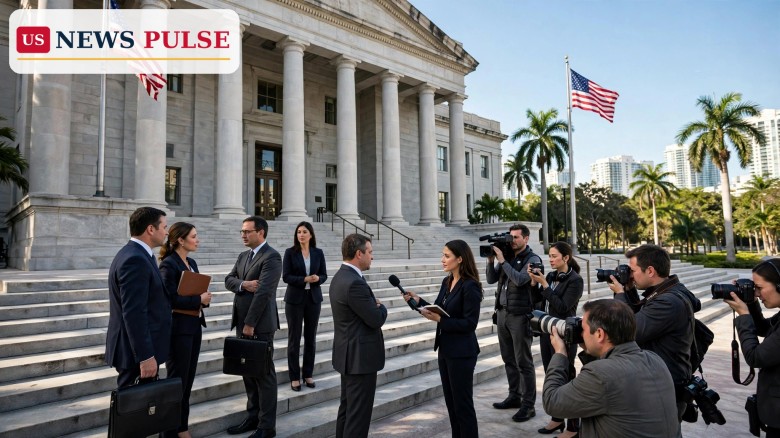
A federal judge on Saturday, October 31, 2026, dismissed President Donald Trump's Wall Street Journal lawsuit for good, ending the president's defamation case over the newspaper's reporting on a lewd birthday letter to Jeffrey Epstein that bore Trump's name. The ruling, issued by United States District Judge Darrin P. Gayles in Miami, dismissed the case with prejudice, which means Trump cannot file the same claims again.
Gayles ruled that Trump had failed to plausibly allege that the Rupert Murdoch-owned newspaper acted with actual malice, the demanding legal standard a public figure must meet to win a defamation case in the United States. The judge found that the president's revised complaint still did not fix the flaws that led him to throw out the original case in April.
Key Points
- Judge Darrin P. Gayles dismissed Trump's lawsuit against The Wall Street Journal for a second time on Saturday, October 31, 2026.
- This time the dismissal was with prejudice, so the president cannot refile the same defamation claims.
- Gayles ruled Trump failed to plausibly allege actual malice by the Journal in its 2025 reporting on an Epstein birthday letter.
- Trump sued Dow Jones, News Corp, Rupert Murdoch and two reporters in July 2025, seeking at least $10 billion on each of two claims.
- Dow Jones said it was pleased with the decision; the White House did not immediately respond to a request for comment.
What Happened
The case centred on a Journal report published last year which said that a book assembled for Epstein's 50th birthday in 2003 included a letter with typewritten text framed by the outline of a naked woman and signed simply, "Donald." The story was headlined, "Jeffrey Epstein's Friends Sent Him Bawdy Letters for a 50th Birthday Album. One Was From Donald Trump." Trump has denied writing the letter and accused the Journal of knowingly publishing a false story.
Trump sued the Journal's publisher Dow Jones, its parent companies, News Corp chief executive Robert Thomson and chairman emeritus Rupert Murdoch, and two Journal reporters in federal court in July 2025. The lawsuit brought two defamation claims, each seeking at least $10 billion in damages.
Gayles first dismissed the case in April, ruling that Trump's original complaint relied on what he called formulaic assertions of malice that came nowhere close to the legal standard for a public figure. Crucially, that dismissal was without prejudice, giving Trump a chance to file an amended complaint addressing those shortcomings. On Saturday, the judge found that the revised complaint still failed to resolve those issues.
Trump Wall Street Journal Lawsuit: Why the Judge Ruled Against the President
In Saturday's ruling, Gayles said Trump's allegations "are conclusory, vague, sometimes inconsistent with the article, and often irrelevant" to his argument that the Journal published the 2025 report with actual malice. Actual malice, under long-standing American defamation law, requires proof that a publisher knew a statement was false or recklessly disregarded whether it was false. Merely getting a story wrong, or publishing over a subject's denial, is not enough.
The judge also rejected Trump's argument that the Journal should have withheld its story after he denied writing the letter, saying such a requirement would violate the First Amendment. "Were that the law, any time a public figure or his team denies an accusation, journalists would be immediately blocked from publishing negative or contradictory press," Gayles wrote, according to CNN's account of the ruling.
"The Court agrees that President Trump's defamation claims lack merit," Gayles wrote. The judge, who was appointed by former President Barack Obama, is based in Miami. A spokesperson for Dow Jones, the Journal's parent, told CNN: "We're pleased with the court's decision." The White House did not immediately respond to CNN's request for comment.
Background and Context
The lawsuit was especially unusual because Trump brought it while serving as president. Legal analysts who spoke with CNN said they could not recall another instance of a sitting president suing a news outlet over a story. At the same time, the case fits a long-running pattern for Trump, who has used the courts for decades to pressure news organisations over coverage he dislikes, and who has stepped up that campaign during his second term.
The Epstein birthday letter itself has become one of the most politically charged artefacts of the Epstein saga. Epstein, the disgraced financier and convicted sex offender, died in jail in 2019 while awaiting trial on sex-trafficking charges. Questions about who knew what about his conduct, and about the circle of powerful friends he cultivated, have fuelled years of reporting, congressional inquiry and litigation. Trump has repeatedly denied wrongdoing in connection with Epstein and has said he cut ties with him long before Epstein's downfall.
For the Journal, the ruling is a significant legal vindication, but it arrives in a media environment in which even winning lawsuits carries a cost. Legal experts quoted in coverage of the case have described several of Trump's media suits as frivolous and full of holes, while warning that winning may be beside the point: the publicity and the threat of protracted, expensive litigation can themselves pressure news outlets and chill aggressive reporting.
Reactions and Quotes
"We're pleased with the court's decision," a Dow Jones spokesperson told CNN after Saturday's ruling. Press freedom groups, which have denounced Trump's suits against news organisations, were expected to welcome the decision as another defeat for the president's legal campaign against the American news media, CNN reported.
The judge's own words were unsparing. Describing Trump's allegations as "conclusory, vague, sometimes inconsistent with the article, and often irrelevant," Gayles left little room for doubt about his view of the revised complaint. His First Amendment warning — that a rule requiring journalists to hold a story whenever a public figure denies an accusation would block negative or contradictory reporting outright — is likely to be quoted well beyond this case.
The White House had not responded publicly by the time the ruling was reported on Saturday. Whether Trump will appeal the dismissal was not immediately announced.
Why It Matters
The decision matters first because it closes, at least at district-court level, one of the highest-profile media lawsuits ever brought by a sitting president. A dismissal with prejudice is a final judgment on those claims: Trump cannot simply refile a tweaked version, as he did after the April dismissal. Any further challenge would have to come through an appeal, a different and steeper path.
It matters second for press freedom. The actual-malice standard exists precisely to give journalists breathing room to report on powerful people without fear that an error, or a subject's denial, will itself become a winning lawsuit. By reaffirming that standard so bluntly, and by rejecting the idea that a denial alone should kill a story, Gayles has reinforced a protection that underpins much American political reporting.
It matters third because of what it signals about Trump's wider legal campaign against the press. The Journal case was the flagship of that campaign, filed with a headline-grabbing $20 billion demand against one of the world's most prominent newspapers and its 94-year-old owner. Its failure, twice, suggests the courts are applying the same standards to the president's claims as to anyone else's — and finding them wanting.
What Happens Next
The immediate question is whether Trump appeals. The White House and Trump's lawyers had not announced a next step when the ruling was reported. An appeal would take the case to a federal appeals court, where a panel of judges would review whether Gayles applied the law correctly — a process that could take many months.
Meanwhile, Trump's other media lawsuits continue on their own tracks. During his second term he has also filed a $15 billion defamation case against The New York Times over its coverage of his 2024 campaign; a judge dismissed the original complaint last year but allowed Trump to refile, and in July deferred a decision on the Times' motion to dismiss while directing Trump to revise his complaint again, which he did in August. Late last year, Trump sued the BBC for $10 billion over its editing of his January 6, 2021, speech in a documentary about the Capitol attack; the broadcaster has vowed to defend the case in court.
One month before taking office, Trump sued Iowa pollster J. Ann Selzer, her polling company, The Des Moines Register and its parent company over a poll released days before the 2024 election showing him trailing Democratic nominee Kamala Harris in Iowa. A judge dismissed that lawsuit with prejudice in September. The Journal ruling now joins that result as the second with-prejudice dismissal of a Trump media-related suit in as many months.
Frequently Asked Questions
What did the judge decide? Judge Darrin P. Gayles dismissed President Trump's defamation lawsuit against The Wall Street Journal with prejudice on Saturday, October 31, 2026.
What does with prejudice mean? It means the case is dismissed finally and Trump cannot file the same claims again, unlike the April dismissal, which was without prejudice and allowed a revised complaint.
What was the lawsuit about? A 2025 Journal report that a book for Jeffrey Epstein's 50th birthday in 2003 included a letter, signed "Donald," with text framed by the outline of a naked woman. Trump denied writing it.
Why did Trump lose? Gayles ruled Trump failed to plausibly allege actual malice — that the Journal knew the story was false or recklessly disregarded the truth — the standard a public figure must meet.
Can Trump appeal? No next step had been announced when the ruling was reported; a dismissal with prejudice can ordinarily be appealed to a higher court, but Trump cannot simply refile the case.
Related coverage: Trump's Ohio tele-rally backs Ramaswamy and Husted; Senate votes 51-47 to end Trump's global tariff emergency; Rubio says interest grows in limited Black Sea ceasefire.
© 2026 US News Pulse. All rights reserved.
 Print
 Save