
LAPD Shooting in Downtown LA: Suspect Wounded After Striking Officer
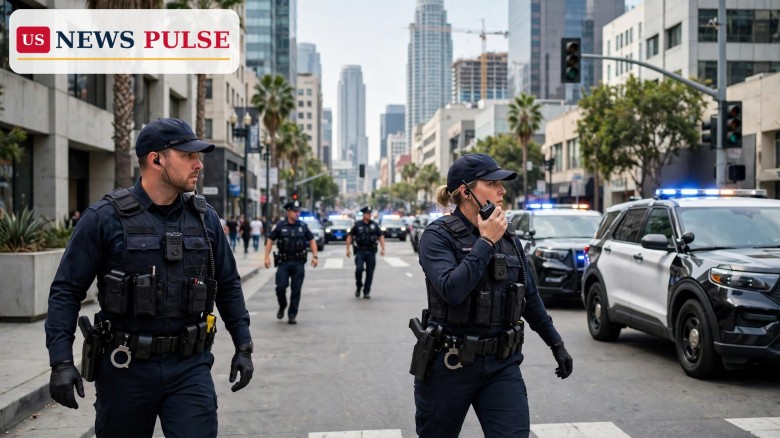
Los Angeles police officers shot and wounded a 48-year-old robbery suspect in downtown Los Angeles on Saturday, October 31, 2026, after police say he struck an officer with a metal pole despite repeated orders to drop it and less-lethal rounds that failed to stop him.
Key Points
- The LAPD shooting happened shortly before 1:30 p.m. on Saturday, October 31, 2026, near East Fourth and Omar streets in downtown Los Angeles, police said.
- Central Division officers were responding to a report of a robbery suspect when an LAPD air unit directed them to the man, identified by police as Bernard Deshawn Douglas, 48.
- Police say Douglas was carrying a roughly four-foot metal pole with a bladeless tree-pruning shear attached to one end, and a four-foot tree branch.
- Officers fired 40mm less-lethal rounds, which police say were ineffective. Douglas then advanced and struck an officer on the left arm and shoulder with the pole, prompting the shooting.
- Both Douglas and the injured officer were taken to hospital and listed in stable condition. The officer was later treated and released, and no bystanders were injured.
What Happened
According to the Los Angeles Police Department, Central Division patrol officers responded on Saturday afternoon to a radio call reporting a robbery suspect near Fourth Street and Omar Street in downtown Los Angeles. An LAPD air unit helped direct officers to the suspect, who was carrying the metal pole and the tree branch. The department's account, reported by MyNewsLA, KTLA, KABC-TV and KNBC, is the basis for the sequence that follows, and the department itself has described the information as preliminary.
Officers told Douglas repeatedly to drop the objects, police said. He allegedly refused, turned toward officers and raised the pole and branch above his head. Officers then fired 40mm less-lethal rounds, described in some reports as foam rounds, but police say they had no effect. That failure of the less-lethal option is a central part of the department's account, because it explains why officers then faced a man still holding a metal pole at close range.
Police say Douglas then advanced toward an officer and struck that officer on the left arm and shoulder with the metal pole. At that point, officers opened fire. Douglas was struck by gunfire and attempted to walk away, according to police. An officer deployed a Taser, causing him to fall to the ground, and he was taken into custody without further incident. Officers gave medical aid until Los Angeles Fire Department paramedics arrived and took Douglas to a hospital.
The injured officer was also taken to a hospital, treated and released. Both men were listed in stable condition, police said, and no other injuries were reported. The metal pole and the tree branch were recovered and booked as evidence. The scene near Fourth and Omar streets was expected to be shut down for several hours while investigators worked, according to early reporting.
LAPD Downtown Shooting: What Police Have Not Said Yet
Several important details remain unconfirmed, and this article does not fill them in. Police have not described the robbery that prompted the original call, what, if anything, was taken, or whether Douglas is charged in connection with that robbery as well as with the confrontation with officers. No charging announcement was included in the reports checked for this article, and readers should not assume a charge from the fact of an arrest and a shooting alone.
Police have also not said how many shots were fired, where Douglas was struck, or how many officers fired. Those details are normally part of a Force Investigation Division review, and departments often hold them back while that review is under way. The LAPD's Force Investigation Division is investigating the shooting, as it does in officer-involved shootings, and the department has said there is no ongoing threat to the community connected to the incident.
There is also a small timing difference in early reporting that is worth noting plainly rather than smoothing over. Most reports place the shooting shortly before 1:30 p.m. on Saturday, with some giving 1:25 p.m. as the time officers responded. That few-minute difference does not change the sequence, but it is a reminder that the first hours of reporting on a fast-moving police incident can differ on precise times, and that the department's formal investigation, not the first news alerts, is the authoritative record.
Background: Less-Lethal Force and Officer-Involved Shootings
The LAPD account follows a pattern that police departments describe as an escalation ladder: verbal commands first, then less-lethal tools, then, when those fail and an officer faces an immediate threat, lethal force. In this case, officers gave repeated commands, then used 40mm less-lethal rounds, and only then, after the pole strike, opened fire. Whether that sequence was justified is a question for the Force Investigation Division and, in due course, for prosecutors and any civilian oversight process — not a conclusion this article reaches on the basis of the department's own preliminary account alone.
Less-lethal rounds, including 40mm foam rounds, are designed to incapacitate or deter a person without killing them, but they do not always work, particularly against a person who is moving, is holding an object, or is not deterred by pain or impact. Police trainers stress that less-lethal tools are not a guarantee, and that an officer who has tried them and is then attacked with a weapon may have little time to try a second option. That context helps explain why the department highlighted the failure of the less-lethal rounds in its statement, but it does not, by itself, settle whether the shooting was lawful or necessary in the circumstances.
Downtown Los Angeles is a dense, busy area, and a confrontation on a Saturday afternoon near Fourth and Omar streets could easily have involved bystanders. Police say no bystanders were injured, which is a significant fact in itself. It also means that the investigation will focus on the officers, the suspect and the recovered pole and branch, rather than on additional victims or witnesses who were hurt.
It is also worth placing this shooting in its immediate context without linking it to unrelated incidents. The Halloween weekend produced several separate shootings across the United States, including shootings in Boulder, Colorado, Birmingham, Alabama, and DeKalb County, Georgia. There is no evidence that the downtown Los Angeles shooting is connected to any of them. It involved a different police department, a different set of circumstances — a robbery call and a pole attack on an officer, rather than a party, a football game or a domestic call — and it should be judged on its own facts.
Reactions
The principal official reaction so far is the LAPD's own statement, as reported by local television and MyNewsLA. The department confirmed the time and place, the robbery call, the air unit's role, the objects Douglas was carrying, the failed less-lethal rounds, the pole strike, the shooting, the Taser deployment, the custody, and the stable condition of both men. Its closing reassurance — that there is no ongoing threat to the community — is aimed at residents and businesses in downtown Los Angeles who may have seen the heavy police presence on Saturday afternoon.
No statement has yet been reported from Douglas, his family, or a lawyer acting for him, and no statement has been reported from the injured officer beyond the department's account of his treatment and release. That silence is normal in the first days after an officer-involved shooting, when the injured officer is recovering, the suspect is in hospital and in custody, and investigators are still taking statements.
Local coverage has reflected the department's account closely, with the New York Post, KTLA, KABC-TV and KNBC all reporting the same core sequence: a robbery call, a man with a metal bar and a tree branch, repeated orders to drop them, failed less-lethal rounds, a charge and a strike on an officer, and then gunfire. The consistency of that sequence across outlets strengthens confidence in the outline, even though the finer details — charges, shot count, and the robbery itself — remain to be confirmed.
Why It Matters
It matters first because an officer was struck with a metal pole in broad daylight in the centre of a major American city, and a suspect was shot in response. Both men survived, and both were listed as stable, but a pole strike to the arm and shoulder and a gunshot wound are serious injuries, and the officer's release from hospital does not by itself mean a quick return to duty. The department has not said when the officer might return to work.
It matters second because the case will test how the LAPD's use-of-force review works in practice. The Force Investigation Division will examine the commands, the less-lethal deployment, the pole strike and the shots, and will consider body-camera and surveillance material, witness statements and the recovered evidence. That review, and any decision by prosecutors on charges against Douglas, will determine whether the shooting is treated as justified, and whether Douglas faces charges for the robbery, for assault on an officer, or for both.
It matters third because it is a reminder of the risks of a seemingly routine call. Officers responding to a robbery report do not know what they will find when they arrive, and a suspect carrying a metal pole and a branch is not a situation that can be resolved by a simple arrest. The air unit's role in directing officers to Douglas also shows how police in Los Angeles use aerial support to locate a suspect quickly in a dense downtown area, before a confrontation develops further.
What Happens Next
The Force Investigation Division inquiry will continue, and the department is expected to release more detail — including any charges against Douglas, the nature of the original robbery call, and the outcome of the use-of-force review — when it judges that doing so will not compromise the investigation. Any announcement of charges, a change in either man's condition, or a finding by the investigation would be a new development, and this site will report it when police announce it, not on the basis of unverified social media claims.
For residents of downtown Los Angeles, the immediate danger appears to have passed. Police say there is no ongoing threat connected to the incident, and the scene was cleared after investigators finished their work on Saturday. The longer questions — what robbery prompted the call, what charges Douglas will face, and whether the shooting is found to be within policy — will be answered by the investigation and, if charges follow, by the courts.
Frequently Asked Questions
What happened in the downtown Los Angeles LAPD shooting?
On Saturday, October 31, 2026, LAPD Central Division officers responding to a robbery-suspect report near Fourth and Omar streets encountered Bernard Deshawn Douglas, 48, who was carrying a metal pole and a tree branch. After repeated orders and ineffective less-lethal rounds, police say Douglas struck an officer with the pole, and officers then shot him. He was taken into custody after a Taser deployment.
Who is Bernard Deshawn Douglas?
Police identified the man as Bernard Deshawn Douglas, 48, a robbery suspect. Further personal details, and any charges against him, have not been announced in the reports checked for this article.
How is the injured officer?
The officer was struck on the left arm and shoulder, taken to a hospital, treated and released, and listed in stable condition. Police have not released the officer's name.
Was anyone else hurt?
No. Police say no bystanders were injured, and there is no ongoing threat to the community connected to the incident.
What is still unknown?
What robbery prompted the original call, how many shots were fired, where Douglas was struck, and what charges he will face. The LAPD Force Investigation Division is investigating, and police describe the information so far as preliminary.
Related coverage: Two DeKalb officers shot responding to domestic call, suspect in custody; Boulder Halloween shooting kills CU student, 1 critical in party attack; Birmingham Magic City Classic shooting: mayor reveals two attacks, teen held.
Sources: Los Angeles Police Department, via MyNewsLA, November 1-2, 2026; New York Post, October 31, 2026; KTLA, KABC-TV and KNBC reporting, October 31, 2026. The featured image is an illustrative generated scene of a police response in downtown Los Angeles, not an actual photograph of the Fourth and Omar streets incident. Police describe the information as preliminary and the investigation as in its early stages.
© 2026 US News Pulse. All rights reserved.
 Print
 Save