
Venezuela Democratic Transition: US Urges Phased Plan After Rubio Talks
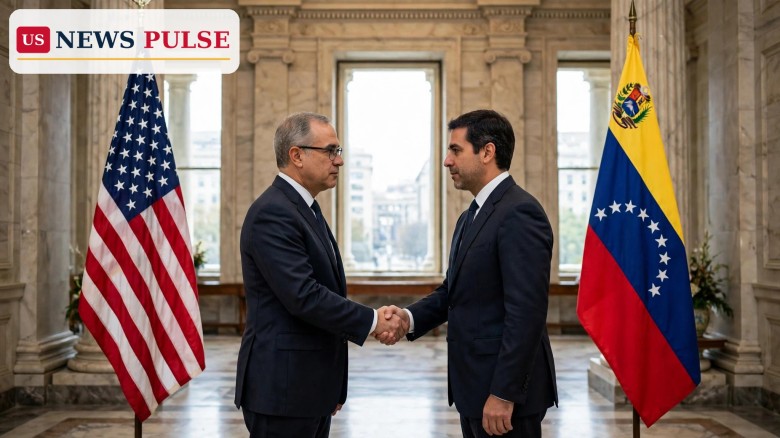
The United States has urged Venezuela to stay on a phased path toward democratic transition, pressing Caracas to complete economic recovery and political reconciliation before moving to democratic elections. The message came out of a meeting in Washington on Monday, November 2, 2026, between Secretary of State Marco Rubio and Venezuelan Foreign Minister Oliver Blanco, and it sets the clearest public sequence yet for how Washington wants Venezuela's political future to unfold.
Key Points
- Secretary of State Marco Rubio met Venezuelan Foreign Minister Oliver Blanco at the State Department on Monday, November 2, 2026.
- Washington reaffirmed President Donald Trump's three-phase plan: stabilisation, economic recovery and political reconciliation, then democratic transition.
- Opposition leader Maria Corina Machado returned to Venezuela last week and said elections should follow in 2027.
- Interim President Delcy Rodriguez has promised elections with the world as witness, but has not named a date.
- A September oil deal gives Washington a stake in about one-fifth of Venezuela's oil resources, a point Machado has criticised for its lack of transparency.
What Happened
Rubio and Blanco discussed the political future of Venezuela at the State Department on Monday. Neither man spoke to reporters after the meeting. In a readout, the State Department said Washington had reaffirmed President Trump's three-phase plan for Venezuela: stabilisation, economic recovery and political reconciliation, and democratic transition.
The meeting comes nearly a year after US forces seized former Venezuelan President Nicolas Maduro in Caracas and brought him to the United States to face drug-trafficking charges. Since then, Delcy Rodriguez, who served as Maduro's vice president, has led Venezuela as interim president, while Washington has worked with her government on oil and on a political sequence that stops short, for now, of an election date.
Background: A Year After Maduro's Seizure
Maduro's removal reshaped Venezuela's politics and its relationship with Washington. The Trump administration has since pursued two tracks at once: deepening American commercial involvement in Venezuelan oil, and pressing for a political process that it says must run in stages. That dual approach is the backdrop to Monday's meeting, and it explains why the State Department's readout emphasised order and sequence rather than a single election announcement.
In September, the Trump administration said it had struck a deal with Venezuela that would give Washington a stake in about one-fifth of the country's oil resources. Under the arrangement, the United States said it was creating a joint venture with North American Blue Energy Partners, known as NABEP, owned by Venezuelan businessman Alejandro Betancourt and described as the second-largest private oil operator in Venezuela, behind Chevron. Caracas is giving the company 100-year rights over 17 oilfields with proven reserves of 65 billion barrels. The Pentagon will hold a 35 percent stake in NABEP, and the United States will be guaranteed the right to buy 20 percent of its oil output at cost, the administration said.
Venezuela Democratic Transition: The Phased Plan Explained
The three-phase plan, as reaffirmed on Monday, begins with stabilisation, moves through economic recovery and political reconciliation, and only then reaches democratic transition. The deliberate ordering matters. Washington is signalling that it does not want a rushed vote in unsettled conditions, and that economic repair and a measure of political reconciliation should come first. For Venezuelans waiting for a ballot, however, the same sequence can read as delay, which is why the next steps, and any dates attached to them, will be watched so closely.
Machado, a Nobel Peace Prize laureate who gave her medal to Trump in 2025, returned to Venezuela last week, thanking the president and Rubio for their support. She said she had come to organise a movement in preparation for Venezuelan elections, and she described Rubio's sequence as one aimed at moving toward a democratic transition that makes clear the holding of presidential elections in 2027.
Reactions and Quotes
Machado has balanced a campaign posture with public scepticism about the oil agreement. In remarks after returning to Venezuela, she said the agreement does not reflect the levels of transparency that Venezuelan society wants. Her criticism is notable because it comes from an opposition leader who has publicly thanked Washington, and it points to a tension inside the American approach: commercial deals with the interim government on one side, and demands for openness and democratic change on the other.
Shortly before Machado's statements on Thursday, Rodriguez assured the nation that elections would be held in Venezuela with the world as witness, but she did not specify a date. When asked about a possible meeting with Rodriguez, Machado said she had not received any message from the interim president or from Washington. That silence leaves the most important meeting of all, between the interim government and the opposition, still unarranged.
Why It Matters
Venezuela holds some of the world's largest proven oil reserves, and its political direction affects migration across the Americas, energy markets, and the credibility of Washington's claim that the post-Maduro order will end in democracy rather than in a new arrangement of convenience. A phased plan gives the interim government time and gives Washington leverage through oil and recognition. It also carries a risk: the longer elections are postponed, the harder it becomes to argue that transition is the destination rather than the slogan.
For the opposition, the stakes are personal as well as political. Machado is trying to build an electoral movement while the government she hopes to replace still controls the state, and while Washington deals with that same government on oil. Her return, and her willingness to criticise the oil deal openly, suggest she intends to keep some distance from both Caracas and Washington even as she works toward a 2027 vote.
What Happens Next
Three questions will shape the next phase. First, whether Rodriguez names an election date, or at least a timetable, beyond her promise of elections with the world as witness. Second, whether Machado and the interim government open direct contact, something Machado says has not happened. And third, whether the oil joint venture proceeds as described, and whether its terms become more transparent in response to the criticism already voiced. Any one of those developments would mark a genuine step forward; together, they would show whether the phased plan is a road map or a holding pattern.
Washington's message on Monday was therefore both a reassurance and a warning: the plan has not changed, the sequence still stands, and the election phase has not yet arrived. What remains unresolved is when it will.
Frequently Asked Questions
What did the United States urge Venezuela to do?
Washington urged Venezuela to continue on a phased plan of economic recovery and political reconciliation before embarking on democratic elections, reaffirming President Trump's three-phase plan.
Who met in Washington on Monday?
Secretary of State Marco Rubio met Venezuelan Foreign Minister Oliver Blanco at the State Department on November 2, 2026. Neither spoke to the media afterwards.
When does Maria Corina Machado expect elections?
Machado said Rubio's sequence makes clear the holding of presidential elections in 2027. Interim President Delcy Rodriguez has promised elections but has not named a date.
What is the Venezuela oil deal with the United States?
A September deal creates a joint venture with North American Blue Energy Partners, giving Washington a stake in about one-fifth of Venezuela's oil resources, with 100-year rights over 17 oilfields holding 65 billion barrels of proven reserves.
Why has Machado criticised the oil deal?
Machado said the agreement does not reflect the levels of transparency that Venezuelan society wants, even as she thanked President Trump and Secretary Rubio for their support.
Related coverage: Iran says it downed US aircraft near Qeshm Island; Trump says he would pardon Musk and aides if Democrats investigate; Trump backs Blakeman in final New York push.
Note: the featured image is an illustrative generated scene of a diplomatic meeting, not a photograph of the Rubio-Blanco meeting.
© 2026 US News Pulse. All rights reserved.
 Print
 Save