
Komyshuvakha Bodycam Shows Final Moments Before Double-Tap Strike Killed 40
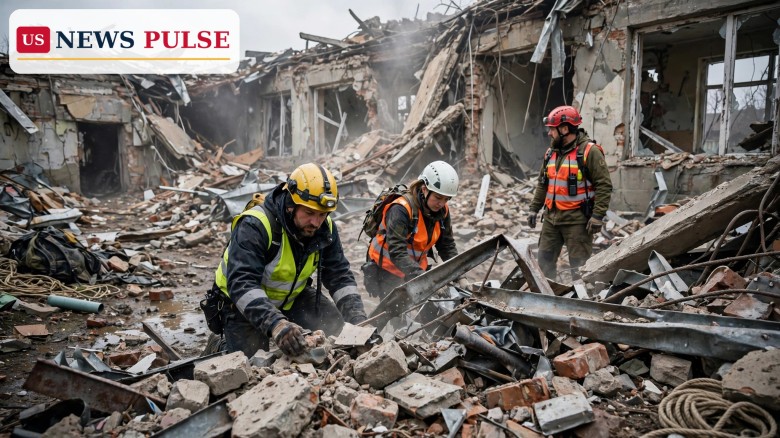
Komyshuvakha bodycam footage released by Ukraine's national police has given the world its clearest view yet of the attack on a humanitarian aid centre in the Zaporizhzhia village, showing residents amid rubble after a first strike and police officers ushering them into a shelter moments before a second strike hit. The video, published on Wednesday, November 4, 2026, was recorded by a police officer who was later killed in the attack, and it ends abruptly when the shelter itself is struck. Ukrainian President Volodymyr Zelenskyy said the same day that nine aerial bombs were dropped, that 40 people have now been reported killed, and that more than 30 people may still be trapped under the rubble on the third day of searching.
Key Points
- Ukraine's national police released bodycam footage on November 4, 2026, recorded by an officer who was later killed in the Komyshuvakha strike.
- The footage shows residents in rubble after the first strike on November 2, then police moving them into a shelter at least two floors underground after a radio warning of more incoming glide bombs.
- President Volodymyr Zelenskyy said nine aerial bombs were dropped, with 40 people reported killed, up from 33 on Tuesday, and more than 30 people possibly still under the rubble.
- BBC Verify confirmed the video was filmed in the same place as aftermath footage from Ukraine's emergency service, the DSNS.
- The United Nations human rights mission in Ukraine said on Tuesday that the bombing likely violated international law; Russia has not publicly commented.
What Happened
The attack began on Monday, November 2, 2026, in Komyshuvakha, in Ukraine's Zaporizhzhia region, where residents had gathered to collect humanitarian aid near a local school. According to President Zelenskyy, Russian forces first struck the people collecting aid, then struck again as rescuers and police arrived. That double-tap pattern is what makes the footage important as evidence: the camera does not cut away before the second blow.
In the opening moments, residents are seen amid rubble after the first strike. Police move through the wreckage, directing people toward cover. Then comes a radio warning that more glide bombs are incoming, and the footage shows police ushering residents into a shelter at least two floors underground, a familiar routine in frontline communities where shelters have become part of daily life.
Then the recording stops: the shelter itself is hit. The death toll has risen steadily since Monday, from 26 in the first reports to 33 by Tuesday and 40 by Wednesday, according to President Zelenskyy. More than 30 people were still possibly under the rubble on the third day of searching, and some of the dead have not yet been identified.
Background and Context
Komyshuvakha lies in the Zaporizhzhia region of south-eastern Ukraine, close to the front line. Schools and other public buildings there have often served as humanitarian hubs, because they are known, central places where residents gather for aid. The site was not, in Ukrainian officials' accounts, a military installation, but a school and nearby shelter where civilians had come for help.
Komyshuvakha Bodycam Video: What the Footage Shows
The Komyshuvakha bodycam video matters for three reasons: what it shows, what it confirms, and what it cannot yet prove. What it shows is the sequence described above, in order: rubble after the first strike, police directing civilians, a warning of further glide bombs, a move at least two floors underground, and then a second strike that ends the recording. That sequence, captured by a participant rather than a bystander, gives investigators and journalists a timeline anchored in the officer's own movements.
What it confirms is location. BBC Verify confirmed the video was filmed in the same place as aftermath footage released by Ukraine's State Emergency Service, the DSNS. That cross-check matters because war-zone videos are routinely questioned or mislabelled. What the footage cannot yet prove, on its own, is who dropped the bombs or the full death toll, which rest on Ukrainian official reporting and rescue work still under way.
Reactions and Quotes
President Zelenskyy addressed the attack on Wednesday, November 4, setting out the central figures: nine aerial bombs dropped, 40 people reported killed, and more than 30 people possibly still under the rubble. He described a first strike on people collecting aid near a local school, followed by strikes on rescuers and police.
The United Nations human rights mission in Ukraine said on Tuesday that the bombing likely violated international law. Its use of the word "likely" reflects the caution of a body that has not yet completed a full investigation, but its intervention is still significant. Russia has not publicly commented on the bodycam release, the revised toll, or the UN assessment.
Why It Matters
The release matters because it changes how the attack is understood. A death toll can feel abstract; a camera worn by an officer who guides people underground and then does not survive makes the pattern concrete: first the aid queue, then the rescuers, then the shelter. Such footage has also become key evidence in investigations of alleged war crimes, because it preserves a sequence that competing claims can blur.
What Happens Next
Rescue work continues, and the immediate next step is grim but essential: search teams must work through the rubble, recover bodies, and identify the dead. Until that work is complete, the figure of 40 reported killed and more than 30 possibly trapped should be treated as provisional. Investigators are also likely to examine the footage alongside DSNS material and witness accounts, but any formal finding on international law will take longer than the news cycle.
Frequently Asked Questions
What does the Komyshuvakha bodycam footage show?
It shows residents amid rubble after a first strike on November 2, police ushering them into a shelter at least two floors underground after a radio warning of more glide bombs, and then the shelter being hit. The officer wearing the camera was later killed.
How many people have been reported killed in Komyshuvakha?
President Volodymyr Zelenskyy said on November 4 that 40 people have been reported killed, up from 33 on Tuesday. More than 30 people were still possibly under the rubble, and some bodies had not yet been identified.
Has the footage been verified?
BBC Verify confirmed the video was filmed in the same place as aftermath footage from Ukraine's emergency service, the DSNS. That confirms the location, though it does not by itself prove every element of the wider account.
What has the United Nations said?
The UN human rights mission in Ukraine said on Tuesday that the bombing likely violated international law, before the footage was released; a full investigation would be needed for a formal finding.
Has Russia responded to the bodycam release?
Russia has not publicly commented on the bodycam release, the revised toll, or the UN assessment, according to the reporting available for this article.
Related coverage: Russian Bombs Kill 26 at Ukraine Aid Centre School in Komyshuvakha, Kyiv Says — our original report on the November 2 strike. Readers can also follow our World News section for continuing coverage of the war in Ukraine.
© 2026 US News Pulse. All rights reserved.
 Print
 Save