
One Killed, Two Critically Hurt as Helicopter Crashes into Biscayne Bay off Key Biscayne
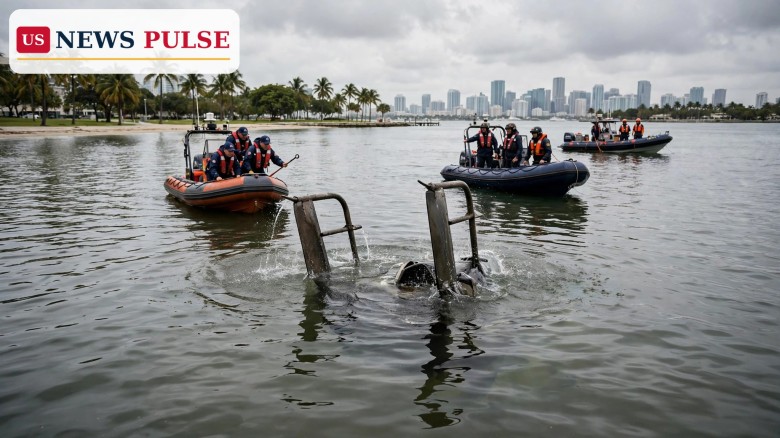
One man was killed and two others were critically injured when a Robinson R44 II helicopter on a photography flight crashed into Biscayne Bay off Key Biscayne, Florida, late on Wednesday morning, November 4, 2026. The helicopter, carrying three adult men, came down in the water near Bill Baggs Cape Florida State Park and ended up upside down, with only its landing skids visible above the surface. Rescue crews rushed to the scene and took the two survivors to hospital, where they were reported to be in critical but stable condition.
Key Points
- A Robinson R44 II carrying three adult men crashed into Biscayne Bay off Key Biscayne on Wednesday morning, November 4, 2026, killing one and critically injuring two.
- The helicopter was filming boats on the water, having left North Perry Airport in Pembroke Pines shortly before 11 a.m.
- It came down near Nixon Beach, off the 1200 block of Crandon Boulevard, at about 11:15 a.m.; the crash was reported at about 11:30 a.m. ET.
- The two survivors are in critical but stable condition at Ryder Trauma Center, according to Miami-Dade Sheriff Rosie Cordero-Stutz.
- The NTSB leads the investigation, with the FAA involved; the identities of those aboard had not been released.
What Happened
The Key Biscayne helicopter crash unfolded quickly on a morning that had begun as a routine aerial photography job. The Robinson R44 II, a four-seat light helicopter widely used for sightseeing, photography and training, left North Perry Airport in Pembroke Pines shortly before 11 a.m. Its mission was to film boats on the water in Biscayne Bay, the sheltered water between Miami and Key Biscayne.
At about 11:15 a.m., the helicopter came down in the bay off the 1200 block of Crandon Boulevard, near Nixon Beach and close to Bill Baggs Cape Florida State Park at the southern tip of Key Biscayne. First responders found the aircraft upside down in the water, with only its landing skids breaking the surface. Miami-Dade Fire Rescue responded at 11:26 a.m., and the United States Coast Guard said the crash was reported at about 11:30 a.m. ET. One person was reported deceased, and two others were transported by emergency medical services to a higher level of care. The two survivors were taken to Ryder Trauma Center at Jackson Memorial Hospital. Sheriff Cordero-Stutz said both men were in critical but stable condition. Their names had not been released, and it was not clear who was flying.
Background and Context
Key Biscayne is a village on a barrier island connected to Miami by the Rickenbacker Causeway, and its waters are among the most photographed in South Florida. Bill Baggs Cape Florida State Park, at the island's southern end, draws visitors for its historic lighthouse, beaches and views across Biscayne Bay toward the Miami skyline. The bay is busy with recreational and commercial boats, and a difficult place for a forced landing.
The Robinson R44 II is one of the most common light helicopters in the world, powered by a single piston engine and carrying a pilot and up to three passengers. Federal investigators will examine the wreckage, maintenance records and weather before reaching conclusions. Early reports gave no indication of the cause, and officials stressed that the investigation was at a very early stage.
The crash is the second fatal aviation incident in South Florida in less than a week. On Sunday, November 1, 2026, a Learjet crashed near Greenacres in Palm Beach County, killing all nine people aboard. That separate accident remains under investigation, but the timing has sharpened public attention on aviation safety in the region.
Key Biscayne Helicopter Crash: What Investigators Will Examine
The National Transportation Safety Board is leading the investigation, with the Federal Aviation Administration also involved. Investigators will begin by recovering the wreckage from the bay and documenting the condition of the rotor system, the engine and the flight controls. Recovery from the water is a careful operation, and immersion can complicate the search for clues.
Investigators will also review the helicopter's maintenance history, the pilot's qualifications and recent flight experience, and the weather at the time of the flight. They will seek video from the flight itself and from boats, shoreline cameras and witnesses. No cause has been announced, no mechanical failure has been confirmed, and no suggestion has been made that weather, pilot error or any other single factor was responsible. Aviation investigations typically take months, with a preliminary report expected in weeks.
Reactions and Quotes
Official reaction on Wednesday was limited to the factual updates released by the responding agencies. The Coast Guard confirmed the time of the report and the outcome for the three people aboard, while Miami-Dade Fire Rescue and the Sheriff's Office provided the hospital update on the two survivors. Sheriff Cordero-Stutz's office said both survivors were in critical but stable condition at Ryder Trauma Center. Authorities asked for privacy for the families while the investigation continues.
Why It Matters
The crash matters first and foremost because a man lost his life and two others suffered critical injuries on what should have been an ordinary working flight. The findings will matter to operators who fly light helicopters over water in South Florida. Any mechanical or operational finding could affect how similar flights are planned.
The accident also highlights the particular risks of flying low over water. A helicopter losing power over land has landing options not available over a bay, and a water impact brings the dangers of inversion and rapid cabin flooding. For readers following other recent aviation investigations in Florida, this crash is a reminder that the region has seen two very different fatal accidents within a few days. Readers tracking the wider run of emergencies affecting South Florida this week will also find this story part of a difficult few days for the region.
What Happens Next
In the coming days, investigators are expected to recover the helicopter from Biscayne Bay and transport it to a secure facility for detailed examination. A preliminary report with the basic facts is expected within weeks, but will not state a cause. Meanwhile, the two survivors remain under treatment at Ryder Trauma Center, and authorities are expected to release the identities of those aboard once next of kin have been notified. Witnesses with video of the flight may be asked to share it with investigators.
Frequently Asked Questions
Where did the Key Biscayne helicopter crash happen? Biscayne Bay off Key Biscayne, Florida, near Nixon Beach and the 1200 block of Crandon Boulevard.
How many people were aboard, and what happened to them? Three adult men were aboard; one was killed and two are in critical but stable condition at Ryder Trauma Center.
What kind of helicopter was involved? A Robinson R44 II, a four-seat light helicopter, on a photography flight from North Perry Airport in Pembroke Pines.
What caused the crash? Not determined. The NTSB leads the investigation, with the FAA involved.
Is this connected to the Greenacres Learjet crash? No, it is a separate incident. It happened less than a week after the November 1 Learjet crash near Greenacres that killed nine people.
© 2026 US News Pulse. All rights reserved.
 Print
 Save