
Trump and Hegseth Underwater in Military Poll as Troops Eye Early Exit
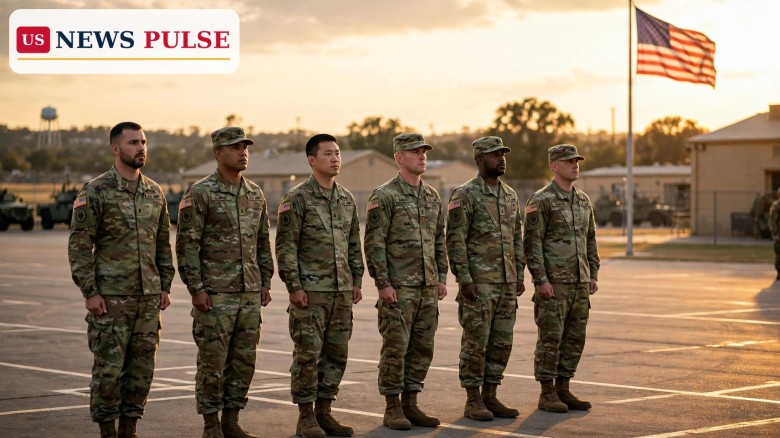
A new Trump Hegseth military poll delivers a blunt verdict from inside the armed forces: President Donald Trump and Defence Secretary Pete Hegseth are both underwater with the troops and veterans they lead, and about half of active-duty service members say they now want to leave the military sooner because the institution is becoming more politicised.
Key Points
- Roughly 50% of respondents disapproved of President Donald Trump as commander-in-chief, against 47% who approved, while Defence Secretary Pete Hegseth split about 45% in favour to 50% against.
- Some 53% of active-duty service members said they want to separate sooner because the military is becoming more politicised, and 45% said policy changes or uncertainty under the Trump administration made them consider leaving sooner.
- Two-thirds of those surveyed, 67%, said decisions affecting service members are made for political gain rather than mission readiness, against 25% who disagreed.
- Roughly 79% said politicians and society are leaving veterans and military families behind, with 48% strongly agreeing and only 15% disagreeing.
- Senior uniformed commanders fared far better than either civilian leader, with 56% approving of top generals and admirals and 27% disapproving.
What Happened
Common Defense Civic Engagement conducted the poll between September 15 and 18, 2026, surveying 731 active-duty service members, veterans and military families. The survey carries a margin of error of plus or minus four percentage points. The results were released in late October and reported publicly on November 2 and 3, days before the 2026 midterm elections.
The headline numbers are striking because of who was asked. Common Defense said its sample "skews older, whiter, more male, and more Republican" — a group that might be expected to lean towards a Republican commander-in-chief. Instead, Trump drew a net-negative rating, and Hegseth a similar split.
The most consequential findings concern retention. A majority of active-duty respondents, 53%, said they want to separate sooner because the military is becoming more politicised, and 45% said policy changes or uncertainty under the Trump administration had made them consider leaving sooner. An early-exit trend on that scale would carry real costs in training, leadership and institutional knowledge.
The poll also points to a deep sense of grievance beyond the barracks. About 79% said politicians and society are leaving veterans and military families behind, with nearly half, 48%, strongly agreeing — a finding that cuts across partisan divides.
Background and Context
Common Defense is a grassroots organisation of veterans that works on behalf of service members and military families. Its latest survey is notable for the breadth of its questions, covering approval of civilian leaders, the reasons troops stay or leave, and whether they believe the institution still serves its mission.
It is also worth noting what the poll does not do. It surveyed 731 people, and while the margin of error is modest, it is not a census of the armed forces. Its value lies in the direction of the findings and in their consistency: across questions about approval, politicisation, retention and neglect, the answers point the same way.
What the Trump Hegseth Military Poll Reveals About Readiness
The most important number in the survey may not be an approval rating at all. It is the 67% who said decisions affecting service members are being made for political gain rather than mission readiness. Only a quarter of respondents disagreed. That is a judgment about how the military is run, not about any one leader, and it goes to the heart of what the armed forces are for.
When troops believe that promotions, assignments, deployments and discipline are shaped by political considerations, trust in the chain of command erodes. The poll suggests that erosion is already under way.
The contrast with senior uniformed commanders is telling. Top generals and admirals earned 56% approval against 27% disapproval, far stronger than either Trump or Hegseth. Service members appear to distinguish between the uniformed leadership they serve alongside and the civilian leadership above them, trusting the former while doubting the latter.
Reactions and Quotes
Jose Vasquez, the executive director of Common Defense and a US Army veteran, did not soften the organisation's reading of the results. He called the findings "a readiness crisis", arguing that the survey shows a force under strain from the inside. "Active-duty troops are telling us that politicization is pushing them toward the exit," he said.
The language matters. Vasquez framed the issue not as a partisan dispute but as a threat to the military's ability to do its job: a force that loses experienced people faster than it can replace them faces gaps in leadership, training and operational skill that take years to close.
Why It Matters
The survey matters because retention is the quiet crisis of any all-volunteer force. Recruitment gets the headlines, but experienced service members train new recruits, lead units and carry institutional memory. If a majority of active-duty troops are thinking about leaving early, the effects will show up in readiness reports and in the quality of leadership at every level.
It also matters because the military's relationship with its civilian leadership is built on trust. The principle of civilian control is fundamental, but it works best when troops believe civilian leaders act in the interests of the mission. The poll suggests that belief is fraying — a warning the administration will find hard to ignore as the new Congress takes shape after the midterms.
What Happens Next
The poll is likely to feature in the debate over military policy in the months ahead, as lawmakers and veterans' groups press the administration on retention, morale and the politicisation of the armed forces. Retention data in the coming quarters will show whether the 53% who said they want to leave sooner follow through.
Frequently Asked Questions
What did the Common Defense poll find about Trump and Hegseth?
About 50% of respondents disapproved of President Donald Trump as commander-in-chief, against 47% who approved. Defence Secretary Pete Hegseth had a similar split, with about 45% approving and 50% disapproving.
How many active-duty troops want to leave the military sooner?
Some 53% of active-duty service members surveyed said they want to separate sooner because the military is becoming more politicised, and 45% said Trump administration policy changes or uncertainty made them consider leaving sooner.
Who conducted the poll and how many people were surveyed?
Common Defense Civic Engagement conducted the poll between September 15 and 18, 2026. It surveyed 731 active-duty service members, veterans and military families, with a margin of error of plus or minus four percentage points.
What did troops say about politics and readiness?
Some 67% said decisions affecting service members are being made for political gain rather than mission readiness, while 25% disagreed. About 79% said politicians and society are leaving veterans and military families behind.
How did senior military commanders rate in the poll?
Senior uniformed commanders fared far better: 56% approved of top generals and admirals, and 27% disapproved.
Related coverage: Trump Hush Money Conviction Challenged as Lawyers Ask Appeals Court to Toss It, Ro Khanna Vows Bill to Cut Off Funding for the Iran War After Democrats Take Congress, and Alito and Thomas Won't Retire, Sources Say, as Sweep Closes Trump's Court Window.
© 2026 US News Pulse. All rights reserved.
 Print
 Save