
France Protests: 70,000 Police Deployed as Cost-of-Living Unrest Grips France
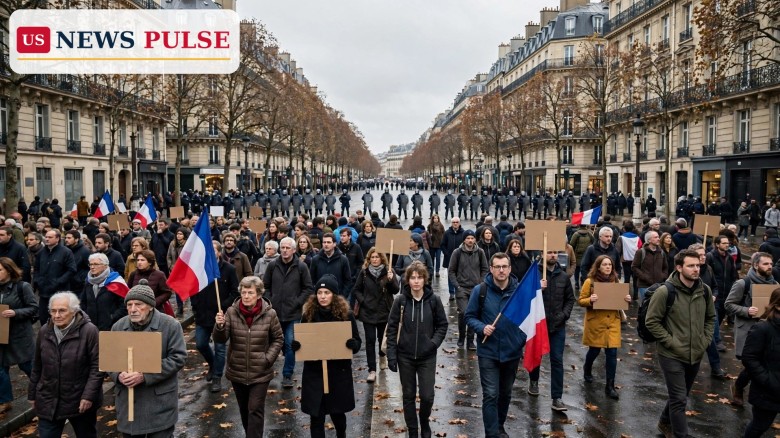
France was gripped by fresh nationwide protests on Thursday, November 5, 2026, as demonstrators marched in cities across the country over the rising cost of living and the state of public services. The government deployed 70,000 police and other security officers to keep 220 planned demonstrations peaceful, in the latest flare-up of weeks of unrest.
Key Points
- The government deployed 70,000 police and other security officers for 220 demonstrations planned across France on Thursday, November 5, 2026.
- The movement began in late September with student protests over underfunded schools and has broadened into a wider challenge over living costs and public services.
- The government is considering raising the minimum wage, now 1,478 euros ($1,659) net a month since June; the CFDT, France's biggest union, wants at least 100 euros more.
- Household confidence fell in October to its lowest since June 2013, and the 10-year bond yield hit 5.14 percent last month, its highest since 2002.
- More demonstrations are planned for Saturday, as weekly since October 17, and unions and housing groups have called for pan-European protests from November 20 to 22.
What Happened
Trade unions and student groups mobilised demonstrators across France on Thursday for a nationwide day of action, with marches in Paris and in cities and towns across the country. The government mobilised 70,000 police and other security officers to ensure the 220 demonstrations passed peacefully, a show of force designed to avoid a repeat of the nationwide demonstrations on October 17 that caught security forces off guard and spiralled into clashes and looting.
That October day produced some of the worst street violence and looting France has experienced in years. Students, teachers, health workers and other public-sector staff marched alongside trade union members, reflecting a movement that has spread well beyond Paris and beyond its student origins.
Background and Context
The movement began in late September with protests by students over underfunded schools, but it has broadened into a wider challenge to the government. Pupils and teachers complained of staff shortages, overcrowded classrooms and crumbling buildings,
The government has so far resisted broad measures on the cost of living as it struggles to keep the budget deficit under control. For students, it has pledged to send some 3,000 qualified teachers to fill staffing gaps, plus smaller classes and 4 billion euros in loans for school renovations. The minimum wage has stood at 1,478 euros ($1,659) net a month since June, when it rose by 35 euros to reflect inflation.
France Protests and the Cost-of-Living Squeeze
The France protests are being driven above all by pressure on household budgets. Prices have risen faster than pay for many workers, and household confidence fell in October to its lowest level since June 2013, according to the statistics office's monthly consumer survey. When families feel poorer and less certain about the future, they spend less, and that caution feeds back into an economy already under strain.
The turmoil complicates a fiscal crisis and adds to pressure from higher energy prices. The minority government is struggling to pass spending cuts in a deeply divided parliament as part of its 2027 budget and is at risk of being toppled if no compromise can be found. The unrest has also added to investors' concerns over France's fiscal outlook, pushing the 10-year bond yield to 5.14 percent last month, its highest since 2002.
Reactions
The government has responded with a mix of security and concessions: the deployment of 70,000 officers for Thursday's marches was the clearest signal it intends to prevent a repeat of the October 17 violence, while on policy it has pointed to the teacher deployment, smaller classes and 4 billion euros in school renovation loans, and said it is considering a minimum wage increase. Critics say those steps address only the edges of the problem.
The political reaction has been sharper. Hard-left candidate Jean-Luc Melenchon has seen a poll bump, despite criticism from the government for backing the protesters' demands and not clearly condemning the violence. He says President Emmanuel Macron should yield to the protesters or leave office. Polls indicate the unrest is benefiting far-right candidate Marine Le Pen, already the frontrunner to replace Macron. Macron's former prime minister Edouard Philippe trails both and may miss the May 2 runoff if he does not regain momentum.
Why It Matters
France's protests are not unique in Europe, although they have been among the biggest in a wave of Gen Z-led demonstrations across the continent this year. In Frankfurt, hooded rioters looted stores late last Saturday after tens of thousands marched in Germany's biggest cities. Clashes erupted in Italy last month over poor public services and living costs, while Spain and Portugal have faced protests over housing.
For France, the stakes are higher than in most of its neighbours. It is the eurozone's second-largest economy. There is also the question of what comes after Macron, who will step down at next year's election after a decade in power. If the protests help the candidates at the extremes, as polls suggest, the outcome could reshape France's relationship with the European Union, its fiscal policy and its approach to law and order.
What Happens Next
The immediate test comes on Saturday, when a grassroots movement backed by some unions holds a new round of demonstrations, as weekly since October 17. Unions and housing associations have also called for pan-European protests from November 20 to 22. In Paris, the budget fight continues and a minimum wage decision is expected; if the increase falls well short of the 100 euros the CFDT demands, the unions are likely to keep the pressure on through the winter.
Frequently Asked Questions
Why are people protesting in France?
The protests began in late September with students demonstrating over underfunded schools, and have broadened into a wider movement over the cost of living and public services,
How many police were deployed for the November 5 protests?
The government mobilised 70,000 police and other security officers for 220 demonstrations across France on Thursday, November 5, 2026, hoping to avoid a repeat of the clashes and looting of October 17.
What is France's minimum wage?
France's minimum wage has stood at 1,478 euros ($1,659) net a month since June 2026, when it rose by 35 euros to reflect inflation. The CFDT union wants an increase of at least 100 euros net a month.
Will the protests continue?
Yes. A grassroots movement backed by some unions plans new demonstrations on Saturday, as weekly since October 17, and unions and housing groups have called for pan-European protests from November 20 to 22.
How is the unrest affecting France's economy and politics?
Household confidence fell in October to its lowest since June 2013, the 10-year bond yield hit 5.14 percent, its highest since 2002, and polls suggest the unrest is benefiting Marine Le Pen and Jean-Luc Melenchon.
Related coverage: Global dockworkers strike hits 113 ports in 22 countries over arms shipments and McDonald's US sales slip 0.2% in third quarter as fewer customers visit. Sources: Reuters, November 5, 2026.
© 2026 US News Pulse. All rights reserved.
 Print
 Save