


 | Today's Date:





Iran Says Four Hormuz Tankers Destroyed by Naval Mines in New Strait Claim
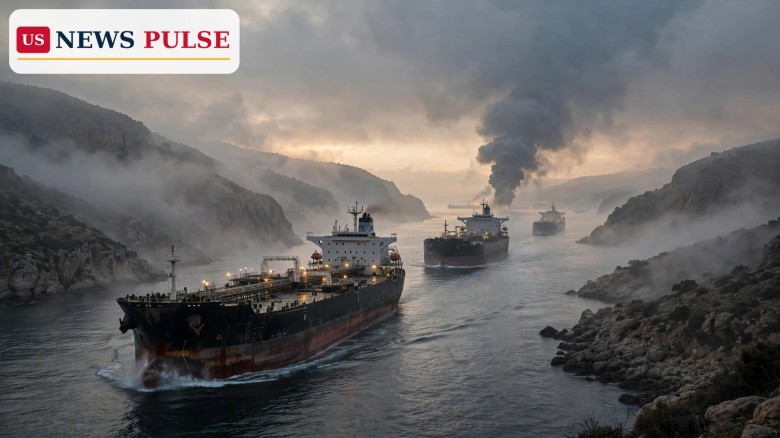
Iran's Islamic Revolutionary Guard Corps said on Wednesday, November 4, 2026, that four oil tankers were destroyed after striking naval mines near the Strait of Hormuz, and that it had also shot down a United States MQ-9 drone over the strait. Both claims could not be independently verified.
Key Points
What Happened
Iran's Revolutionary Guard said the four tankers were trying to pass through a prohibited passage south of the Strait of Hormuz when they struck naval mines. According to the reports, the vessels were destroyed and were still burning. The Guard described them as non-compliant, meaning that, in its account, they had tried to use a route Tehran had barred. No detail about the route, the timing of each reported strike, or the vessels beyond that description was included.
The same account said two other non-compliant ships or vessels were halted or detained for violating shipping restrictions. Again, no names, flags, owners, cargoes or crew numbers were published. That absence of identifying detail is central to how the claim should be read: it is an Iranian military claim carried by state outlets, not a confirmed incident backed by named vessels, photographs, or confirmation from a shipping company, an insurer, or another government.
Background: The Strait and the Shipping Dispute
The Strait of Hormuz is one of the world's most sensitive shipping chokepoints, linking the Persian Gulf with the Gulf of Oman and the wider Indian Ocean. Tanker traffic through the strait has been at the centre of the confrontation between Iran and the United States for months, with each side accusing the other of threatening commercial shipping and using the waterway as leverage in a wider dispute over sanctions, naval restrictions and Iran's nuclear programme.
This is not the first tanker claim of its kind in recent days, and that sequence matters. A separate claim on Tuesday, November 3, concerned three tankers, and a separate reported strike concerned a tanker near Oman. Wednesday's claim of four tankers destroyed by naval mines is a distinct, later claim, not a retelling of those reports. The numbers, the mechanism described and the date are different, even though the setting and the actors are the same.
Iran Hormuz Tankers: Reading the Claim
The Iran Hormuz tankers claim rests on two ideas Tehran has repeated: that certain passages are prohibited, and that vessels using them face consequences. Calling the four tankers non-compliant frames the reported destruction not as an attack on ordinary commercial shipping, but as enforcement against vessels that broke restrictions Iran says it imposed.
For shipping companies, insurers and crews, however, the practical question is different. They need to know which passages are affected, which vessels are involved, and whether the waterway is safe to transit. On those questions, Wednesday's reports offered little that could be checked independently. Without vessel names, positions or corroboration, a company cannot reroute around a named incident, and an insurer cannot assess a specific loss.
Reactions and Verification
The claims were carried by Iranian state television and IRNA and attributed to the Revolutionary Guard. That sourcing should be stated plainly, because it shapes how much weight the claims can carry on their own. State outlets in wartime routinely carry military claims without independent verification, and the reports reviewed included no confirmation from the United States, a Gulf state, a shipping operator, or an independent maritime monitor.
Iran's wider message alongside the claims was that the US reply to its Hormuz plan was unconvincing, and that no one would benefit from a return to war. The warning presents Tehran as seeking a diplomatic path while also asserting that it will enforce its restrictions in the strait. No response from Washington to Wednesday's specific claims was included in the reports reviewed, and no casualty or crew information was published.
Why It Matters
The Strait of Hormuz matters far beyond the countries that border it because so much of the world's seaborne oil and gas passes through it. When claims of mines, strikes or detained vessels circulate, even unverified ones, they can affect shipping decisions, insurance calculations and energy prices, as operators weigh caution against the cost of delay. That is why a claim involving four tankers, if confirmed, would be significant, and why an unconfirmed claim still deserves careful, clearly labelled reporting.
The timing also matters. The claims arrived while diplomacy over a Hormuz plan was still being discussed and while warnings about a return to war were being exchanged. In that context, a military claim can function as pressure, as deterrence, or as a domestic signal of resolve, and sometimes as more than one at once. Separating the claim from its possible purposes is difficult in real time, which is why this article keeps the claim, the sourcing and the missing verification in the foreground.
What Happens Next
The next steps are, in practical terms, about verification. Maritime authorities, shipping companies and insurers will look for vessel names, positions, distress signals, or satellite and photographic evidence that can confirm or contradict the claim. Governments with naval or surveillance assets in the region may issue statements, and any such statement would be a significant new development. If no corroboration emerges, the claim will remain an unverified Iranian assertion.
Diplomatically, attention will stay on the Hormuz plan and on whether further exchanges produce a reply that either side describes as workable. The reports noted Iran's view that the US reply so far was unconvincing, which suggests further exchanges, or further public pressure, before any agreement is reached. A return to war, which Iran warned would benefit no one, remains the outcome diplomacy is nominally trying to avoid, even as military claims continue.
Frequently Asked Questions
What did Iran claim on November 4, 2026?
Iran's Revolutionary Guard claimed four non-compliant oil tankers were destroyed after striking naval mines south of the Strait of Hormuz, that two other vessels were halted or detained, and that an MQ-9 drone was shot down over the strait.
Have the tanker and drone claims been independently verified?
No. The reports reviewed attributed the claims to Iranian state television and IRNA, gave no tanker identities or casualty details, and included no independent or US confirmation.
Is this the same as Tuesday's three-tanker claim?
No. Wednesday's claim concerns four tankers said to have hit naval mines, while Tuesday's published reports concerned a separate three-tanker claim and a separate tanker incident near Oman.
Why does the Strait of Hormuz matter?
It is a narrow chokepoint between the Persian Gulf and the Gulf of Oman through which a large share of seaborne oil and gas travels, so incidents or claims there can affect shipping, insurance and energy markets.
What happens next?
Verification is the next step: vessel names, positions, distress signals, photographic evidence, or official statements would confirm or contradict the claims, alongside continued diplomacy over the Hormuz plan.
Related coverage: Iran calls US reply to Hormuz plan unconvincing as tanker hit near Oman; Trump warns of heavy hit on Iran after midterms as Tehran says US voted no to war; Iran says maximum deterrence plan ready for any new US attack.
Leave a Comment