Riverside County ballots are at the centre of a fast-moving election fight in California, after county officials told the United States Justice Department on Thursday, October 29, 2026, that they could not set aside 1,355 mail-in ballots from voters federal authorities suspect are noncitizens. The county said the November 3 midterm election was already under way, a federal judge had already rejected the government's bid to halt counting, and separating those ballots was logistically impossible. The refusal, disclosed in a letter from County Counsel Minh C. Tran, turns a courtroom dispute over more than 20,000 California ballots into a direct standoff between a local election office and Washington, just days before voters decide control of Congress.
The dispute reached Riverside County in a letter dated Monday, October 26, 2026. In it, the Justice Department gave the Riverside County Registrar of Voters 48 hours to commit to helping federal authorities verify the citizenship of 1,355 people on the county's voter rolls, and demanded that the county hold their mail-in ballots until their eligibility could be determined. The department also sought access to voter registration records, including Social Security numbers, driver's licence information and other documents that could help determine whether the voters are United States citizens, and warned that election workers could face criminal consequences if they knowingly counted ballots cast by people ineligible to vote.
On Thursday, October 29, the county answered. In a letter responding to federal prosecutors, County Counsel Minh C. Tran pointed to the court order issued the previous day and to the practical reality of an election already in motion. "In light of the Court's order issued on October 28, 2026, and the logistical impossibility, the ROV is unable to segregate the 1,355 ballots of named individuals as requested," the county's counsel wrote, using the abbreviation for the Registrar of Voters. Riverside County said the November 3 election was already under way and that it could not separate the disputed ballots as requested.
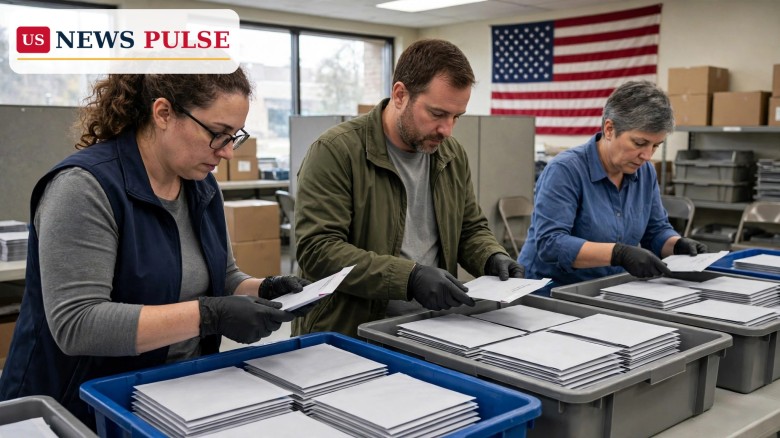
The scale of the county's mail-ballot operation helps explain that position. As of October 30, Riverside County had issued approximately 1.48 million vote-by-mail ballots, including supplemental voter registrations and replacement ballots. Of those, roughly 307,226 had been returned and classified as "good," according to the county Registrar of Voters' website. It was not immediately clear how many of the 1,355 voters suspected by federal authorities had returned their ballots. Election officials in Orange, San Bernardino, Los Angeles, Ventura, Santa Barbara and San Luis Obispo counties have also received similar letters from the Justice Department, so Riverside County's answer is being watched well beyond its own borders.
The Riverside County exchange did not begin in Riverside. It grew out of a federal lawsuit over California's voter rolls that has been building for weeks. The Department of Homeland Security initially claimed that as many as 190,832 noncitizens might be registered to vote in California. California Secretary of State Shirley Weber questioned those findings, and the federal government later produced a list of more than 20,000 people it suspected were noncitizens. The Justice Department then went to court seeking a temporary restraining order that would bar California from counting mail ballots from those voters until their citizenship could be verified.
On Wednesday, October 28, United States District Judge David O. Carter, sitting in Los Angeles, rejected that request in a 26-page order. He found that the Justice Department was unlikely to succeed in its legal challenge and had failed to establish why the court needed to intervene so close to Election Day. He warned that the government's request would "wreak havoc and disrupt the election" and could prevent eligible voters in California from having their votes counted. "Eroded trust in our democracy is irreparable," Carter wrote. "Once a vote is segregated, lasting harm has occurred. If the Executive can discount votes and threaten an ongoing election due to unproven allegations, then our democracy is in danger. This Court declines to be a party to such process."
Carter also questioned the reliability of the federal government's voter list and said its months-long delay in seeking a court order undermined its "eleventh-hour claim of irreparable harm" to the election. He emphasised that federal and California laws already prohibit noncitizens from voting and allow authorities to prosecute illegal voting and remove ineligible voters from registration rolls. He added a historical warning that has since been quoted across the case: "Never before in American history has the federal government, on the eve of an election, sought to coerce a state and local government to abandon their own Constitutional elections procedures and bend to the will of the Executive Branch. But California and its people are sovereign, too."
Riverside County's letter rests on two pillars: the court order and the calendar. Legally, the county argues that it is bound by Carter's October 28 order, which refused to require the segregation the Justice Department is now seeking directly from the county. Practically, it argues that pulling 1,355 named ballots out of a mail-ballot stream of nearly 1.5 million issued ballots, with more than 300,000 already returned and classified as good, cannot be done reliably in the final days of an election that has already begun. The county's phrase, "logistical impossibility," is doing heavy work: it is not a claim that the ballots cannot be found in theory, but that they cannot be separated, verified and held without disrupting a count that is already under way.
The Justice Department's own lawsuit acknowledges part of the difficulty. Carter noted that the department conceded it could not investigate "thousands, let alone tens of thousands" of suspected voters before the election ended. That concession cuts both ways in the public debate. Supporters of the department's position say it proves why ballots should be held first and checked later. Critics, including Carter, say it proves why a last-minute hold would be so damaging: thousands of ballots, many of them cast by eligible voters whose names appear on a disputed list, could be frozen while an investigation that cannot finish in time drags on. Carter warned that holding thousands of ballots could prevent eligible voters from having their votes counted, and that "over 20,000 registered Californians would potentially lose the right that generations of Americans have fought to preserve."
The sharpest language in the case so far has come from the bench. Judge Carter's October 28 order framed the dispute as a clash between federal power and state sovereignty, warning that segregating votes on unproven allegations would cause lasting harm. "Every generation in our history has witnessed repeated clashes between those who seek to limit access to the ballot and those who fight to ensure it," he wrote, a passage that voting-rights advocates have seized on and that the Justice Department will now have to answer on appeal.
Local Democratic lawmakers moved quickly to back the county's handling of the election. United States Representative Raul Ruiz, a Democrat whose district includes the eastern Coachella Valley, toured the Riverside County Registrar of Voters' ballot processing centre on October 29, alongside Democratic Representatives Norma Torres and Mark Takano, to review election security measures and meet with county election officials. After the tour, Ruiz said: "Our elections are safe, fair and secure. We strengthen our democracy by building confidence in our elections. I visited the ballot processing center and saw firsthand the care and professionalism that go into protecting every ballot and ensuring that every voter has an equal opportunity to participate in our democracy."
This dispute matters for three reasons, and none of them is limited to Riverside County. First, it tests who controls an election in its final days: a county registrar following state procedure and a court order, or a federal department demanding a hold on ballots it suspects, but has not proved, were cast by noncitizens. If the Justice Department can persuade counties directly, or win on appeal, the precedent would reach far beyond California, and it would arrive just as other states are facing similar federal demands over voter rolls and election records.
Second, it tests what happens to trust when a voter list is disputed. Carter's concern was not abstract: if eligible voters learn that their ballots were segregated because their names appeared on a list later shown to be unreliable, the damage to confidence is hard to undo, even if the ballots are eventually counted. Conversely, if ineligible votes are counted and discovered later, confidence suffers from the other direction. The court's appointment of a technical expert is an attempt to replace argument with evidence, but that evidence will not arrive before Election Day.
Third, the timing matters. With the November 3 midterms deciding control of Congress, every ballot fight is read through a partisan lens, whether or not the officials involved intend it that way. Riverside County's letter is written in the dry language of election administration, but its effect is political: 1,355 ballots will not be set aside on the federal government's say-so, in a state where the wider fight covers more than 20,000. How the appeals court rules, and how the November 13 hearing unfolds, will shape not only this election's aftermath but the rules for the next one.
The immediate question is whether the federal appeals court acts on the Justice Department's request for a ruling by October 30. The court gave opposing parties until 9 a.m. Friday to respond, so a decision could come quickly, or the court could let the district court's order stand while the appeal proceeds. Either way, Riverside County has already stated its position, and counting in California continues under Carter's order unless a higher court changes it.
Beyond Election Day, the calendar points to November 13, when Carter will hear the Justice Department's request for a preliminary injunction and motions to dismiss the lawsuit, with a technical expert's examination of the federal voter list in the background. That hearing could determine whether the government's broader challenge survives, and whether its list is reliable enough to support future demands. Voters in Riverside County, meanwhile, will have their ballots counted under the procedures the county says it is following, and the county's October 29 letter will stand as the document that said no to Washington, on the record, four days before the polls closed.
How many Riverside County ballots are in dispute? The Justice Department flagged 1,355 voters on Riverside County's rolls as suspected noncitizens and asked the county to hold their mail-in ballots until citizenship could be verified.
Why did Riverside County refuse? The county cited Judge David O. Carter's October 28 order rejecting a bid to set aside California ballots, and said segregating the 1,355 ballots was logistically impossible with the election already under way.
What did the judge actually rule? Carter rejected the Justice Department's request for a temporary restraining order, finding the government unlikely to succeed and warning that segregation would "wreak havoc and disrupt the election."
Are the 1,355 ballots part of a larger dispute? Yes. They are part of a wider California fight over more than 20,000 mail ballots the federal government wants held pending citizenship checks, after an initial claim of up to 190,832 possible noncitizen registrations.
What happens next in the case? The Justice Department has appealed and asked for a ruling by October 30, and Carter has scheduled a November 13 hearing on a preliminary injunction, with a technical expert examining the federal voter list.
Related coverage: California Ballots Ruling: Judge Rejects DOJ Bid to Set Aside 20,000 Votes, California Ballots Appeal: DOJ Asks Court to Rule by Friday on 20,000 Votes, and DOJ Warns Election Officials in All 50 States of Prison Time Over Ballot Records.
Leave a Comment



 | Today's Date: