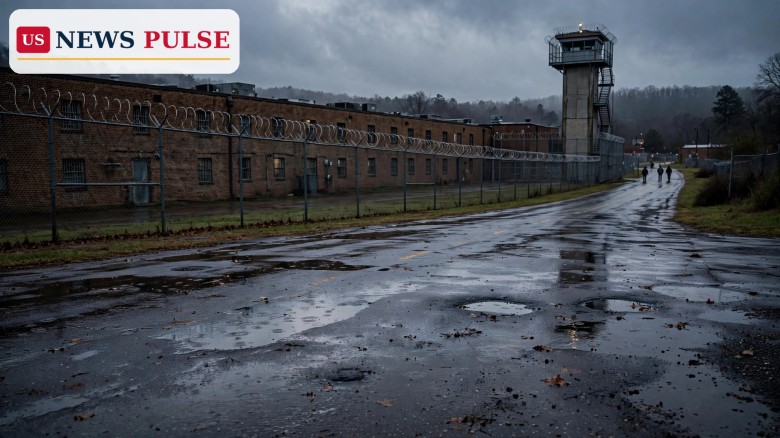
Christa Pike, the Tennessee death-row prisoner who survived a botched execution one month ago, has spoken publicly for the first time since the state tried to put her to death, saying she lives in constant pain and still does not understand why she is alive. In a statement released through her lawyers on Friday, October 30, 2026, the 50-year-old said she had walked into the execution chamber prepared to die, only to wake up alone and confused in a hospital bed days later.
“I don’t know why I survived that night. I don’t know what comes next. Some days, finding hope is harder than others. For now, I am trying to heal, one day at a time,” Pike said. Her words, dictated from the prison infirmary where she is still being held, are the first direct account from Pike herself of a night that has thrown Tennessee’s lethal-injection system into the national spotlight and paused executions across the state.
Pike’s statement was released on Friday by her legal team, one month to the day after the failed execution at the Riverbend Maximum Security Institution in Nashville. It was dictated from the prison infirmary at the Debra K. Johnson Rehabilitation Center, where Pike has been held since October 10 after more than a week in hospital.
“I walked into the execution chamber at Riverbend prepared to die,” Pike said, according to the statement. Instead, she said, she woke up alone in a hospital bed, confused and in pain, with no memory of how she had got there.
“There hasn’t been a moment since that night when I haven’t been in pain. My body hurts. My arms hurt. My hands hurt. My throat hurts. I still struggle to speak. And the pain isn’t just physical. There is pain in my mind and in my soul,” she said.
Pike also spoke of frustration at what she described as incompetence, saying she was “deeply hurt by the incompetence that has put so many people in this terrible position.” At the same time, she thanked the medical staff who saved her life and the people who have offered her compassion and support, and she said she continued to think about the grief and loss of her victim’s family.
“I am drawing strength from the kindness of people who have reminded me that I was not alone,” she said. Her lawyers have since appealed to Governor Lee to commute her death sentence to life imprisonment, arguing that the failed execution, her childhood trauma and her mental illness all weigh against a second attempt.
Pike was 18 years old when she killed her 19-year-old Job Corps classmate, Colleen Slemmer, in Knoxville on January 12, 1995. Prosecutors said Pike, who saw Slemmer as a romantic rival, lured her with her boyfriend Tadaryl Shipp and a friend, Shadolla Peterson, to a wooded area near the University of Tennessee’s agricultural campus, where Slemmer was beaten and stabbed in an attack lasting about half an hour. Pike was arrested within two days and gave police a full statement admitting her role.
In 1996, at the age of 20, Pike was sentenced to death, making her one of the youngest women to receive a death sentence in the United States in the modern era. She has spent three decades on death row and remains the only woman on Tennessee’s death row. Had the September 30 execution gone ahead, she would have become the first woman executed in Tennessee in more than 200 years.
Shipp, who was 17 at the time of the killing and therefore too young to face the death penalty, was sentenced to life in prison with the possibility of parole; his parole request was denied in 2025. Pike’s lawyers have long argued that her sentence does not fit a crime committed at 18, pointing to a childhood marked by sexual abuse from a young age, neglect and untreated mental illness, including diagnoses of bipolar disorder and post-traumatic stress disorder. Slemmer’s mother, by contrast, has said she still wants the sentence carried out after waiting decades.
While on death row, Pike was convicted in 2001 of attempting to murder a fellow inmate, Patricia Jones, by strangling her with a shoelace, and received an additional 25-year sentence. Her execution date was set after years of appeals, and Governor Lee declined to grant clemency before September 30. A last-minute stay from the Sixth Circuit Court of Appeals, issued to review whether her childhood trauma had been fully considered at sentencing, was lifted in time for the execution to proceed.
The Christa Pike botched execution unfolded over more than an hour on the evening of September 30, according to media witnesses and her lawyers, and the full explanation for why it failed has still not been given by the state.
At about 7:26 p.m. Central Time, Pike delivered what was to be her final statement: “I just want to say that I’m going to leave this world the way I spent most of my life. And that is with love.” The first dose of pentobarbital, the powerful barbiturate Tennessee uses for lethal injection, was administered at about 7:30 p.m.
Within minutes, Pike told the chamber her arm felt as if it were about to burst. Witnesses heard her breathing heavily, moaning and snoring, and at times talking, over the following half hour. Her lawyers later said it had taken more than an hour for the intravenous team to establish two lines, that at least seven needles were used on her left arm alone, one of which appeared bent when removed, and that her arms became badly swollen, bruised and blistered, possibly because the drug was leaking into her arm tissue instead of circulating through her bloodstream.
At about 7:46 p.m., officials closed the chamber blinds, presumably to administer a second dose of pentobarbital in line with Tennessee protocol, which provides for a second injection if the first does not work. There is no protocol for what happens if the second dose also fails. Witnesses later reported snoring, grunting and choking sounds. The blinds were closed again at about 8:05 p.m., and after roughly an hour of waiting for Pike to die, the attempt was stopped. Emergency services were called at about 8:40 p.m., witnesses were led out at about 8:53 p.m., and Pike was rushed unconscious to a Nashville-area hospital.
She remained unconscious for days, intubated and on a ventilator, and her lawyers described her condition on October 4 as critical, with doctors still working to clear the drugs from her system. By October 6 she was conscious and talking, despite what her lawyers called severe damage to her arms, and on October 10 she returned to the Debra K. Johnson Rehabilitation Center. Her lawyers have since filed an emergency motion seeking her removal from what they describe as indefinite isolation in the prison infirmary, where they say she had been held for about 20 days.
Pike’s lawyers have described her as the only person known to have survived a complete execution attempt in the United States, a characterisation echoed by the nonprofit Death Penalty Information Center, which said she appears to be the first person known to have survived after execution drugs entered her body. Attorney Stephen Ferrell, who was with Pike on the execution day, has said the state has not explained how the lethal injection could have failed.
“Apparently at no point did any member of the execution team realise that the IV lines were not correctly placed or that the veins had blown and that the pentobarbital was, in whole or in part, entering Ms. Pike’s body,” her legal team said in a court filing, adding that the state then administered a second lethal dose rather than remedying the failure.
The Tennessee Department of Correction has maintained that it followed standard protocol, including the use of a second injection. Governor Lee, speaking around midnight after the failed attempt, said he would open a third-party investigation and paused all remaining 2026 executions in the state. The state’s prison commissioner, Frank Strada, has since resigned. A second execution that had been scheduled in Tennessee this year was postponed.
Lee told reporters earlier this week that he expected Pike’s sentence to remain unchanged unless the courts decided otherwise, a position that sets up a further legal and political fight over whether the state can, or should, try again. Death-penalty critics say the case exposes the unreliability of lethal injection; supporters of the sentence argue that the failure of the procedure does not erase the crime or the jury’s verdict.
Pike’s survival is unprecedented in the modern American death penalty, and it matters far beyond one case. The failed execution was the second to go wrong in Tennessee in four months, and it has forced a reckoning with a method that is often presented as clinical and reliable but depends, in practice, on veins, needles and human judgement under extreme pressure.
Pentobarbital, a barbiturate that slows the brain and central nervous system and can suppress breathing at high doses, became Tennessee’s execution drug after a comprehensive review completed in December 2024, following an earlier halt ordered by Lee in 2022. At the federal level, the Justice Department rescinded its single-drug pentobarbital protocol in January 2025 after a three-year review and paused federal executions. Pike’s case will now be cited in every argument about whether states can guarantee that a lethal injection will work as intended, and about what happens when it does not.
It also raises a question no protocol appears to answer: what is the state’s obligation to a person it has tried and failed to execute? Pike went into the chamber expecting to die and woke up a survivor, in pain, back on death row, with her sentence still standing. Whether that experience itself becomes a legal argument against a second attempt is likely to be tested in the courts in the months ahead.
The immediate next steps are the independent investigation ordered by Governor Lee, the outcome of which has not yet been announced, and the legal motions filed by Pike’s lawyers, including the bid to end her isolation in the prison infirmary and the appeal for clemency. No new execution date has been set, and with all executions paused in Tennessee, none can proceed until the governor lifts the pause or the investigation concludes.
If the investigation finds that faulty intravenous placement caused the failure, Tennessee may be forced to revise its protocol, retrain its execution team or reconsider its drug and method altogether. If Pike’s lawyers succeed in court, her sentence could be commuted to life imprisonment or a second execution could be blocked on the grounds of cruel and unusual punishment. If they fail, the state could set a new date, and the same questions would return with even greater intensity.
For now, Pike remains in the infirmary at the Debra K. Johnson Rehabilitation Center, recovering, in her own words, one day at a time. Her statement ends not with a legal argument but with an admission of uncertainty: she does not know why she survived, or what comes next.
Christa Pike, 50, is a Tennessee death-row prisoner sentenced to death in 1996 for the 1995 murder of her 19-year-old Job Corps classmate Colleen Slemmer in Knoxville. She is the only woman on Tennessee’s death row.
Tennessee administered two doses of pentobarbital at the Riverbend Maximum Security Institution, but Pike survived. Her lawyers say intravenous lines took more than an hour to set and the drug may have leaked into her arm tissue. She was taken unconscious to hospital and later returned to prison.
On October 30, 2026, Pike said she had entered the chamber prepared to die, woke up alone and confused in hospital, and remains in constant physical and mental pain. She said: “I don’t know why I survived that night. I don’t know what comes next.”
Yes. Governor Bill Lee paused all remaining 2026 executions and ordered an independent third-party investigation. The state’s prison commissioner, Frank Strada, has since resigned, and another scheduled execution was postponed.
Possibly, but no new date has been set. Her lawyers have asked Governor Lee to commute her sentence to life in prison, and any second attempt would almost certainly face fresh legal challenges. Lee has said he expects the sentence to stand unless the courts decide otherwise.
Related coverage: Florida sex sting: 281 arrested in Polk County, 11 victims found; Brooklyn jogger stabbed in neck on bike path, attacker still at large; Spirit Halloween shooting kills Detroit man in Madison Heights.
Leave a Comment



 | Today's Date: