


 | Today's Date:





NASA Mars Simulation Crew Emerges After 378 Days Inside Houston Habitat
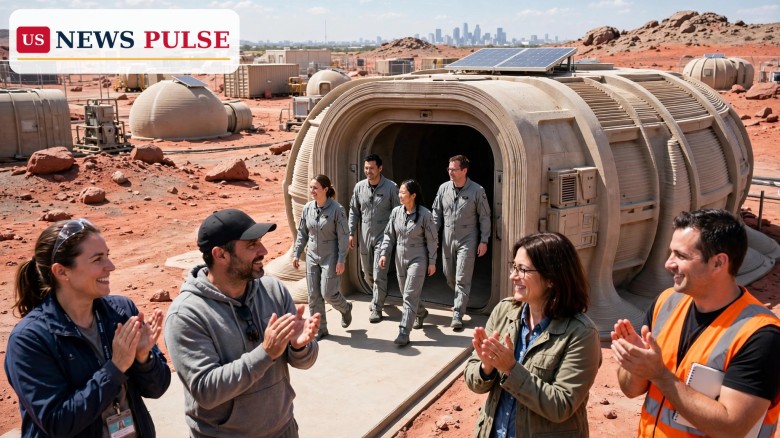
The NASA Mars simulation is over. Four volunteers walked out of a 3D-printed habitat at the Johnson Space Center in Houston on Saturday, October 31, 2026, ending 378 days in isolation designed to test how humans could live, work and stay healthy on the Red Planet. The crew of NASA's Crew Health and Performance Exploration Analog, known as CHAPEA, felt the sun on their skin and embraced family and friends for the first time since 2025, closing the second mission of its kind ever run by the US space agency.
Key Points
- Four CHAPEA volunteers emerged on Saturday, October 31, 2026, after 378 days inside a 1,700-square-foot 3D-printed habitat at NASA's Johnson Space Center in Houston, Texas.
- The crew was commander Ross Elder, medical officer Ellen Ellis, science officer Matthew Montgomery and flight engineer James Spicer.
- They entered the habitat on October 19, 2025, and spent the year growing crops in simulated Martian soil, doing simulated spacewalks and working through delayed communications.
- Ellis called it 'a hell of a year' and said the United States has 'a narrowing window of opportunity to maintain US preeminence in space'.
- The crew now faces two weeks of post-mission evaluations and debriefing with NASA scientists, whose findings will feed plans to return astronauts to the Moon and, one day, send humans to Mars.
What Happened
The four crew members emerged from isolation at the Johnson Space Center on Saturday, greeted by Vanessa Wyche, the centre's director, after 378 days sealed inside a habitat roughly the size of a three-bedroom house. Houston Public Media's Michael Adkison, who was there for their return, reported that the crew felt the sun on their skin and embraced family and friends for the first time since they entered the facility in 2025.
Ellis, the mission's medical officer, spoke for the crew in remarks at the centre after emerging. 'It's been a hell of a year — analog astronauts living in captivity of our own free will,' she said. Elder, the mission commander, struck a note of determination about the larger goal behind the year in isolation. 'For Mars, the risks are great,' he said. 'But through seeking understanding, strong vision and leadership, creativity, fortitude, hard work and incredible foundation, the goal of putting humans on Mars is not only achievable, but rather inevitable.'
The emergence marked the end of NASA's second CHAPEA mission. Another four-person crew spent 378 days in isolation at the Johnson Space Center spanning 2023 and 2024, and the lessons from both missions are now being gathered by NASA scientists studying what long-duration missions beyond Earth demand of the people who fly them.
Background/Context
CHAPEA stands for Crew Health and Performance Exploration Analog. It is a ground-based simulation: no one leaves Earth, but almost everything else about daily life is made to feel like Mars. The habitat is a 1,700-square-foot, 3D-printed structure sitting inside a hangar at the Johnson Space Center in Houston, and for 378 days the four volunteers lived there without leaving, cooking, cleaning, exercising and working in a space not much larger than a family home.
Their days were built around the tasks a real Mars crew would face. They grew crops in simulated Martian soil, studied geology, carried out simulated spacewalks and maintained their habitat with limited resources. They also worked through one of the hardest practical problems of interplanetary flight: communications delays. Messages to and from mission control were held back to recreate the lag inherent in talking across millions of miles, forcing the crew to plan carefully and act independently rather than waiting for an instant reply.
The timing matters for NASA's wider programme. The agency has explored Mars with robotic rovers and orbiting spacecraft, and it has ambitions for a human mission to Mars as early as the 2030s, with plans before that to return astronauts to the Moon for the first time since 1972. CHAPEA exists to answer a question no robot can answer: what does a year-plus on another world do to people, and what do they need to stay healthy, productive and connected while they do it?
Inside the NASA Mars Simulation: 378 Days in a 3D-Printed Habitat
The number 378 is not arbitrary. It mirrors the length of a long-duration surface stay, and it is the same length as the first CHAPEA mission. Over that span, the crew's routine became the experiment. NASA has said it is looking for insight into what it takes for astronauts to adapt to the routines and demands of daily life on long-duration missions beyond Earth — to keep them healthy, productive and connected.
Wyche, who greeted the crew as they exited, said they managed to live with limited resources, maintain their habitat and carry out simulated Mars operations. She also underlined what the communications delays taught them. 'These delays require patience, careful planning and greater independence — qualities that will be essential for future astronauts traveling millions of miles from home,' she said. Those qualities, she added, are exactly what the next generation of explorers will need when a reply from Earth can take many minutes to arrive.
The habitat itself is part of the research. A 3D-printed structure can, in principle, be built on Mars from local materials rather than carried there piece by piece, and living inside one for more than a year tests whether that kind of home is practical as well as possible. The crew grew food, managed supplies and kept the systems running, all inside 1,700 square feet shared by four people who could not step outside for a breath of fresh air.
Reactions/Quotes
Ellis used her remarks to make a case for urgency as well as celebration. 'We have a narrowing window of opportunity to maintain US preeminence in space,' she said, mentioning the service academy for space-related operations pursued by President Donald Trump's administration and plans for a lunar base. 'Let's seize the initiative, lead with science that will benefit our economy and ensure our legacy in space for our children's children,' she said.
Elder framed the mission as proof of concept rather than a stunt. 'For Mars, the risks are great,' he said, 'but through seeking understanding, strong vision and leadership, creativity, fortitude, hard work and incredible foundation, the goal of putting humans on Mars is not only achievable, but rather inevitable.' Wyche closed the loop between the simulation and the real missions it serves, saying the lessons learned from the CHAPEA crew and their experiences will help pave the way for the missions first to the Moon and 'one day, Mars.'
The human side of the return was plain in the reporting from Houston. After more than a year in which every sunrise, meal and conversation happened inside the same small structure, the crew walked out into open sky and into the arms of family and friends. Adkison's account of the day captured that contrast: a year spent learning how humans could live on the Red Planet, ending with the simplest of homecomings.
Why It Matters
A crewed Mars mission is one of the hardest undertakings NASA has ever contemplated, and the hardest parts are not only rockets and radiation. People must live together in a tiny space for years, make decisions with delayed help from Earth, grow some of their own food and stay mentally and physically healthy far from any hospital, shop or open sky. CHAPEA is how NASA studies those problems without first risking lives on a real interplanetary voyage.
The second mission also matters because it repeats the first. One 378-day isolation run could be dismissed as a single anecdote; two runs, with different crews and the same length, give scientists a basis for comparison. Patterns that show up twice — in routines, in conflicts, in coping strategies, in health — are far more useful for designing the real thing than any single crew's story.
There is a competitive edge too, and Ellis said so openly. Her warning about a 'narrowing window' for US preeminence in space reflects a moment in which the Moon and Mars are contested goals, not distant dreams. The crew's own message was that the science done inside a Houston hangar is part of keeping that lead: lead with science, she said, that benefits the economy and secures a legacy in space for future generations.
What Happens Next
The crew's work is not finished at the habitat door. They are set to take part in two weeks of post-mission evaluations and debriefing with NASA scientists, who will measure what the year did to their bodies, their performance and their teamwork, and compare the results with the first CHAPEA mission. Those findings will feed into planning for long-duration stays on the Moon and, eventually, Mars.
NASA's stated sequence remains the Moon first and Mars after. Astronauts are to return to the Moon for the first time since 1972 before any human mission to Mars, which the agency hopes to mount as early as the 2030s. The CHAPEA results will help decide how much autonomy a Mars crew needs, how communications delays should be handled, and what daily routines keep a small crew healthy over a mission measured in years rather than days.
A third CHAPEA mission has not been detailed in the reporting of this emergence, and NASA has not said when, or whether, another crew will enter the habitat. For now, the four volunteers who spent 378 days pretending to live on Mars return to ordinary life — with two weeks of tests ahead, and with their year in isolation now part of the evidence base for the real voyage.
Frequently Asked Questions
What is NASA's CHAPEA mission?
CHAPEA stands for Crew Health and Performance Exploration Analog. It is a ground-based simulation in which a four-person crew lives in isolation inside a 3D-printed habitat at the Johnson Space Center in Houston, carrying out Mars-like tasks to help NASA understand long-duration spaceflight.
How long did the second CHAPEA crew spend in isolation?
378 days. The crew entered the habitat on October 19, 2025, and emerged on Saturday, October 31, 2026 — the same length as the first CHAPEA mission, which ran across 2023 and 2024.
Who were the four crew members?
Mission commander Ross Elder, medical officer Ellen Ellis, science officer Matthew Montgomery and flight engineer James Spicer.
What did the crew do inside the habitat?
They grew crops in simulated Martian soil, studied geology, carried out simulated spacewalks, maintained the habitat with limited resources and worked through delayed communications designed to mimic the lag of interplanetary messages.
When does NASA hope to send humans to Mars?
NASA has ambitions for a human mission to Mars as early as the 2030s, after first returning astronauts to the Moon for the first time since 1972.
Related coverage: Kimi Antonelli becomes youngest-ever F1 world champion at Mexico City GP and Houston storm deaths rise to 8 as Tuesday severe outbreak threatens 25 million.
Leave a Comment