


 | Today's Date:




Learjet Crash: Storm Exploded Skyward as Jet Flew Into Disaster, Data Shows
The Greenacres Learjet crash took a grim new shape on Monday, November 2, 2026, as experts who reviewed flight data and radar said the jet flew into a fast-growing thunderstorm that exploded skyward in the minutes before it fell from the sky, killing all nine people on board. The storm's clouds shot up 15,000 feet in 20 minutes and reached 48,300 feet tall by the time of the crash at 12:50 p.m. on Sunday, meteorologist Matthew Cappucci said, in the clearest picture yet of the weather the crew was trying to outclimb in its final two minutes.
At 12:48 p.m., just two minutes before impact, the first officer asked air traffic control for permission to climb from 35,000 feet to 37,000 feet, citing more precipitation ahead. The mayday call came about 20 seconds later. That sequence, reported by the Palm Beach Post on Monday from flight data and radar reviewed by experts, is now at the centre of the National Transportation Safety Board investigation that began in earnest on Monday at the crash site in Greenacres, Florida.
Key Points
- Experts say the Learjet 60 flew into a fast-growing thunderstorm whose clouds rose 15,000 feet in 20 minutes and topped out at 48,300 feet by the 12:50 p.m. crash.
- At 12:48 p.m., the first officer asked to climb from 35,000 to 37,000 feet because of more precipitation; the mayday came about 20 seconds later.
- Air traffic control audio captured reports of light ice, moderate turbulence that jolted the jet by as much as 700 feet, and an outside temperature of minus 47 degrees Celsius.
- The jet fell from about 35,000 feet to under 9,000 feet in a little over a minute, in an overspeed descent far faster than any normal descent.
- Sunday's crash is the deadliest ever involving a Learjet 60, according to Flight Safety Foundation data, and investigators have not yet determined a cause.
What Happened
The Learjet 60 had departed Austin-Bergstrom International Airport in Texas and was bound for North Eleuthera Airport in the Bahamas when it went down near Military Trail and Cresthaven Boulevard, close to 10th Avenue North, in Greenacres, in Palm Beach County. It crashed at about 12:50 p.m. on Sunday, November 1, exploding into a fireball when it hit the ground and scattering debris over a wide area. Florida Governor Ron DeSantis said the jet fell "like a missile" from the sky.
The final minutes, as captured in air traffic control recordings and flight-tracking data, describe a crew running into weather it could not climb out of. A woman on the flight deck first reported light ice on the aircraft and moderate turbulence. Minutes later she declared a mayday, reported an overspeed condition, meaning the plane was flying faster than its maximum safe speed, and told the controller: "We're gonna crash into the ground."
The descent figures reported on Monday are stark, even allowing for differences between sources. NewsNation reported that the jet entered a steep dive that sped up as it fell, dropping at 10,000 feet per minute, then 20,000, then as fast as 35,000 feet per minute. The Federal Aviation Administration put the descent at about 350 feet per second, which works out to roughly 21,000 feet per minute. Either way, the plane was falling far faster than any normal descent: a commercial flight coming in to land typically drops at somewhere around 1,500 to 3,000 feet per minute. Flight-tracking data also showed the aircraft losing about 27,000 feet in roughly a minute before its signal ended.
On the ground, no one was reported killed or injured by the debris, a mercy that investigators and local officials have repeatedly noted given where the jet came down: on a busy road beside a residential area and near the entrance to a mobile home community. About 600 people from that community were evacuated while federal officials worked at the scene. A flood watch for the area stayed in effect through Monday afternoon, and there were thunderstorms across the peninsula near Lake Okeechobee, with winds from the east at 15 mph gusting to as strong as 25 mph.
Background/Context
The storm itself is the new piece of the puzzle. A thunderstorm that grows 15,000 feet in 20 minutes is not ordinary afternoon weather; it is a rapidly building cell, and its top at 48,300 feet was well above the jet's cruising altitude of 35,000 feet. Climbing two thousand feet, as the first officer requested at 12:48 p.m., would not have taken the aircraft above a storm of that height. That does not, by itself, explain the crash. Investigators have not said whether the ice, the turbulence, the storms or a mechanical problem played a role, and they have stressed that the cause has not been determined.
What is known is that the crew was already dealing with icing and turbulence before the final descent. Ice on an aircraft can change how its wings produce lift and how its controls respond, and moderate turbulence that throws a jet hundreds of feet up or down makes precise control harder still. Experts quoted in Monday's reporting noted that ice and turbulence can contribute to a stall, in which a wing stops producing enough lift. The NTSB will have to test that chain against the wreckage, the flight recorders, the radar track, the air traffic control recordings, the weather data and the maintenance records before it can say what happened, and in what order.
The aircraft itself adds a second line of inquiry. The plane in Sunday's crash, tail number N722BD, was a 22-year-old Learjet 60, built in 2004. Federal Aviation Administration records list its owner as LR60271 LLC, a company based in Wilmington, Delaware, and show its current registration was issued in January 2023. The FAA registry lists the aircraft with 11 seats. Officials have not said who was flying the jet, who chartered or owned the trip, or how many of the nine people on board were crew members.
The Learjet 60 is a twin-engine business jet built by Bombardier, the Canadian company that owns the Learjet brand, developed from the older Learjet 55. It is known for raw performance, able to climb to 41,000 feet in about 18 and a half minutes at full weight, with two Pratt and Whitney Canada engines mounted on the back of the fuselage and a T-shaped tail. Bombardier stopped building the Learjet 60 in 2007 after producing 318 of them. Because the model is older, prices have dropped sharply: by 2018, one could be bought for $1 million or less, putting it within reach of smaller private owners and companies.
Learjet Crash Flight Data: What the Numbers Show So Far
Put together, Monday's flight-data findings describe a compressed, violent final minute. The jet was cruising eastbound near 35,000 feet. The crew reported light ice, moderate turbulence and an outside air temperature of minus 47 degrees Celsius. At 12:48 p.m., the first officer asked to climb to 37,000 feet because of more precipitation. About 20 seconds later came the mayday, with an overspeed report. Then came a descent measured in tens of thousands of feet per minute, from about 35,000 feet to under 9,000 feet in a little over a minute, before the jet struck the road near Military Trail and left a crater and a wide debris field.
Two cautions matter here. First, the descent rates differ between sources because they come from different measurements: NewsNation's account, based on tracking and reporting, describes a dive accelerating to as fast as 35,000 feet per minute, while the FAA's figure of about 350 feet per second works out to roughly 21,000 feet per minute. Those are not necessarily contradictory; a dive that accelerates will have different rates at different moments. Second, a fast descent is a symptom, not a cause. It tells investigators the aircraft lost control or could not be recovered, but not why. That is why the NTSB's work on the ground matters more than any single number.
That work began in earnest on Monday. The NTSB announced that a team of specialists was en route to the crash site to gather evidence, and a spokesperson said the agency would hold a news conference in West Palm Beach, although the time and place had not yet been released as of Monday morning. Investigators were sent to the site on Sunday night and Monday morning, and the FAA is supporting the investigation. The agency typically issues a preliminary report within about 30 days, while a final probable-cause finding can take a year or longer.
Reactions/Quotes
Governor DeSantis, describing the fall, said the jet fell "like a missile" from the sky, a description that has been repeated in almost every account since Sunday because of how steep and fast the final descent appears to have been. Transportation Secretary Sean Duffy, confirming the deaths on Sunday, called the crash a "horrific tragedy" and said the FAA was sending a team to support the NTSB investigation.
In Greenacres itself, the community response on Monday was quieter and more local. Bishop Manuel de Jesus Rodriguez of the Diocese of Palm Beach dedicated an All Souls' Day Mass on Monday to the nine people who died. "As a community of faith, we mourn alongside those who are grieving and unite in prayer for all who have been affected," Rodriguez said in a prepared statement. "I am especially grateful to our firefighters, law enforcement officers, emergency personnel and all first responders for their courageous and selfless service during this difficult time." The Mass was celebrated at Our Lady Queen of Peace Cemetery in Royal Palm Beach, seven miles northwest of the crash site.
Talk of fundraisers for the families spread quickly online after the crash. Chris Salvemini, a spokesperson for GoFundMe, said on Monday morning that the site had not yet received a verified fundraiser related to the crash, a warning against donating to unverified appeals in the name of victims whose names authorities had still not officially released as of Monday morning.
That last point remains sensitive. Authorities had not confirmed the names of those aboard the Learjet 60 as of Monday morning. Family members had, however, identified one person on board to the New York Post: 20-year-old Nathalia Gadelha Filgueiras of Boca Raton, identified as the co-pilot, who earned her private pilot's licence at 17 as a West Boca Raton High School senior, before she had a driver's licence, and who had said her dream was to become a commercial airline pilot. The NTSB does not normally release victims' names, and this article does not treat family identifications as an official manifest.
Why It Matters
Sunday's crash is the deadliest ever involving a Learjet 60, according to Flight Safety Foundation data, and that record matters for a reason beyond the headline. The Learjet 60 carries the highest incident and accident rate of any jet in its class, according to the same data, but most of those accidents happened during landing. Sunday's crash was different: the jet was at cruising altitude when the trouble started. A cruising-altitude loss of control in weather, if that is what the investigation confirms, raises different questions from a landing accident: about weather avoidance at altitude, about icing protection and recognition, about how a crew escapes a rapidly building cell, and about what happens when a jet enters an overspeed descent from which recovery may no longer be possible.
It also matters because of where it happened. A jet falling at tens of thousands of feet per minute onto a busy suburban road, beside homes and a mobile home community, could easily have killed people on the ground as well as everyone on board. That it did not is fortunate, not a reason to minimise the risk: about 600 people were evacuated, roads were closed, a school nearby stayed shut on Monday, and the debris field stretched widely. For communities under flight paths in storm-prone Florida, the crash is a reminder that aviation risk is not confined to airports.
Finally, the crash matters as a test of how quickly reliable information reaches the public. Within a day, the public had a radar picture of the storm, a climb request, a mayday, and a descent rate, but no official cause and no official victim list. That gap is where rumour fills in: unverified fundraisers, speculation about the crew, and premature claims about what "caused" the crash. The NTSB's preliminary report, expected within about 30 days, will be the first authoritative account, and until then the honest position is the one investigators have taken: weather, icing, turbulence and mechanical factors are all still on the table, and none has been ruled in or out.
What Happens Next
The NTSB's West Palm Beach news conference, announced for Monday without a confirmed time or place in the morning updates, is the next expected public step, followed by the on-site work: documenting the wreckage and debris field, recovering the flight recorders, pulling radar and air traffic control data, and examining maintenance records. The Palm Beach County Sheriff's Office and local emergency services will continue to manage road closures and the evacuated community's return as the site is cleared.
Families, meanwhile, face a slower process. Official identification and notification take time, and the NTSB does not normally release victims' names. Anyone wishing to help should wait for a verified fundraiser or an official family appeal rather than donating to unverified online campaigns, as GoFundMe's Monday statement made clear.
For pilots and operators, the questions that will linger longest are operational: how the crew assessed the storm, whether a different route or altitude earlier in the flight could have avoided the cell, and what the icing and turbulence reports meant for the aircraft's performance in those final minutes. Those answers will not come from a single radar image or a single descent figure. They will come, if they come, from the full investigation, and this story will be updated when the NTSB's preliminary report is published.
Frequently Asked Questions
What new information emerged on Monday about the Greenacres Learjet crash?
Experts reviewing flight data and radar said the jet flew into a fast-growing thunderstorm whose clouds rose 15,000 feet in 20 minutes and reached 48,300 feet by the 12:50 p.m. crash, and the Palm Beach Post reported that the first officer asked to climb from 35,000 to 37,000 feet at 12:48 p.m. because of more precipitation, with the mayday about 20 seconds later.
How fast did the Learjet fall?
Reports differ by measurement: NewsNation described a dive accelerating to as fast as 35,000 feet per minute, while the FAA put the descent at about 350 feet per second, roughly 21,000 feet per minute. Both agree the jet fell from about 35,000 feet to under 9,000 feet in a little over a minute, far faster than a normal landing descent of 1,500 to 3,000 feet per minute.
Has the cause of the crash been determined?
No. The NTSB is leading the investigation with FAA support and has not said whether ice, turbulence, storms or a mechanical problem played a role. A preliminary report is typically issued within about 30 days, and a final probable-cause finding can take a year or longer.
Is this the deadliest Learjet 60 crash?
Yes, according to Flight Safety Foundation data cited in Monday's reporting: Sunday's crash, which killed all nine people on board, is the deadliest ever involving a Learjet 60, a model that also carries the highest incident and accident rate in its class, mostly from landing accidents.
Have the victims been officially identified?
Not by authorities, as of Monday morning. Family members identified 20-year-old Nathalia Gadelha Filgueiras of Boca Raton as the co-pilot, but the NTSB does not normally release victims' names, and no official manifest had been published.
Related coverage: NTSB go-team begins Greenacres Learjet investigation after 27,000-foot plunge | Greenacres Learjet co-pilot identified as Nathalia Gadelha, 20, who got her licence at 17 | Greenacres Learjet crash: DeSantis calls it cataclysmic as 600 evacuated
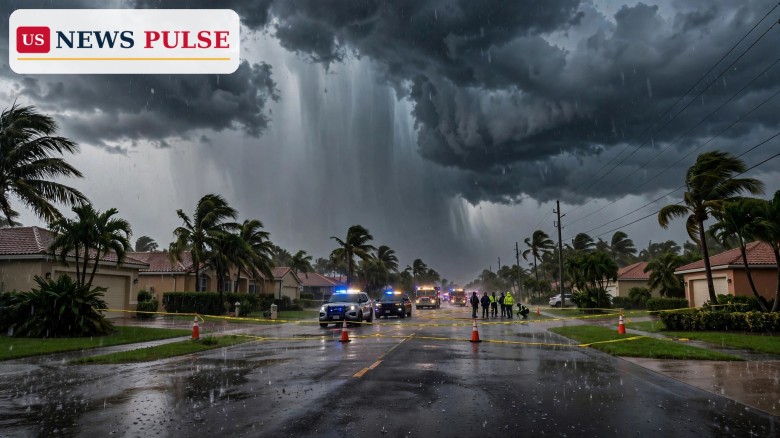
Featured image: an illustrative scene of a towering Florida thunderstorm over a cordoned-off suburban road, not a photograph of the crash itself.
Leave a Comment