President Donald Trump has floated Hollywood tax credits as a way to revive American film and television production, telling a campaign rally in Daytona Beach, Florida, on Friday, October 30, 2026, that executives who once criticised him are now asking for meetings because, in his words, Hollywood is dying and other countries are taking its jobs. The remark came during a wide-ranging midterm speech in which Trump also revived his long-running feud with actor Robert De Niro, calling the 83-year-old Democrat-backing star a moron and mocking his later comedy roles.
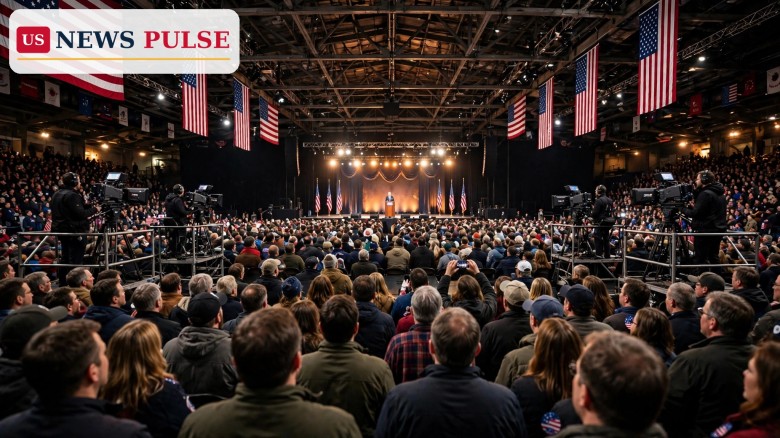
The rally, held at the Ocean Center in Daytona Beach for Republican gubernatorial candidate Byron Donalds, came just four days before the midterm elections on Tuesday, November 3, 2026. Trump used the Hollywood passage to argue that the entertainment industry, once a symbol of American cultural power, now needs help to keep productions — and the jobs that go with them — at home.
Trump veered into Hollywood while discussing his own television past. According to the New York Post, he told the Daytona Beach crowd that “The Apprentice” had beaten “what used to be a great show, the Academy Awards,” before lamenting that the Oscars ceremony now suffers because speakers use foul language about him. It was in that passage that he turned to De Niro.
“By the way, is Robert De Niro a moron? He’s a moron,” Trump said, according to the Post. He continued: “No, there’s something wrong with him. I used to sort of like him or something, but now I can’t even watch him. He’s like gross. Then he goes into the comedies. He’s no good for comedies. Maybe somebody should tell him, but he’s terrible.”
TheWrap reported a similar version of the attack, quoting Trump as saying: “He’s a moron. There’s something wrong with him. I used to sort of like him in some, but now I can’t even watch him. He’s, like, gross.” TheWrap also reported that Trump said of the Oscars: “Now it sucks because people get up and use foul language against your favorite president.”
Trump then mocked Hollywood figures seeking access to the White House. “Now they’re all calling me, kissing my ass. They want tax credits for Hollywood because Hollywood’s dying and other countries are taking away [jobs],” he said, according to TheWrap. “‘Sir, can we please meet you.’ Guys that have been saying bad crap about me for years are sitting in my office, ‘Sir, it’s a great honor to be with you, sir.’”
He went on to impersonate a visiting Hollywood representative pleading to be forgiven for past criticism. “See, the great thing about the Internet is that all you do is you press a button, and it tells you everything they’ve said for the last 20 years,” Trump said. The Post reported a further version of that impersonation, in which the visitor says: “Sir, I’d like to just say before we begin, I was misquoted when I called you an a–hole. They misquoted me. I didn’t say that, sir!”
It is not clear from the reporting which Hollywood celebrities or executives Trump meant when he described meetings in his office, and TheWrap noted that it was not clear which celebrities he claimed had said it was a “great honor” to meet him. Representatives for De Niro and the Academy did not immediately respond to TheWrap’s request for comment, the outlet reported.
Trump and De Niro have clashed in public for years, and the Daytona remarks fit a familiar pattern: a campaign-stage attack on a celebrity critic, followed by a policy hint aimed at an industry audience. The Post suggested Trump was still fuming over De Niro’s “F–k Trump” speech at the 2018 Tony Awards, a moment that became a defining image of celebrity opposition to Trump during his first term.
De Niro, best known for “Taxi Driver,” won two Academy Awards — for “The Godfather Part II” and “Raging Bull,” the Post noted — and later built a second career as a comedy star, including his role as a father in “Meet the Parents” in 2000. That comedy career is exactly what Trump targeted in Daytona, saying De Niro is “no good for comedies” despite the commercial success of those later films.
The Post reported that it was unclear what exactly sparked Trump’s latest ire at De Niro, but pointed to the actor’s fundraising for Democrats ahead of Tuesday’s midterms, including an email solicitation attacking the “Trump/Epstein class” and connecting the president to the late sex trafficker Jeffrey Epstein. TheWrap likewise placed the speech “days away from the 2026 midterm elections” and noted that gas prices, the Iran war and general affordability were hot topics in the campaign.
The rally itself was part of Trump’s final midterm blitz in Florida, campaigning for Donalds in the governor’s race. The Ocean Center crowd heard a speech that ranged across the campaign’s closing arguments, and the Hollywood passage stood out because it combined celebrity mockery with an economic promise: keep film jobs in the United States by making it cheaper to shoot here.
Film and television production has long been shaped by tax incentives, with productions weighing where to shoot based on costs, crews, studios and government support. Trump’s argument in Daytona — that other countries are taking jobs — echoed a complaint often made by American industry figures: that generous incentives elsewhere can pull productions, and the spending and employment that follow, away from the United States. What Trump did not do in the reported remarks was name a country, a programme, a credit rate or a legislative vehicle.
The phrase “Hollywood tax credits” therefore remains, for now, a rally promise rather than a published plan. A tax credit for film and television would normally work by reducing the tax owed by a production company, or by offering a refundable payment, in return for spending and hiring in a particular place. Supporters argue that such credits pay for themselves by attracting spending on hotels, catering, construction, post-production and local crews. Critics argue that they can become a bidding war between places, with taxpayers subsidising productions that would have been made anyway.
Trump’s version, as described in Daytona, was framed less as a detailed economic instrument and more as a response to a complaint from the industry itself. In his telling, the people asking for help are the same people who criticised him for years — and are now, in his words, “sitting in my office” asking for a meeting. That framing turns a policy question into a loyalty story: former critics now need the president’s help to save their industry.
That framing also explains why the remark travelled so quickly online. Clips of the De Niro attack and the tax-credit passage were shared widely on the night of October 30 and into October 31, with the blunt language — “kissing my ass,” “moron,” “gross” — doing much of the work of spreading the clip. The policy content, by contrast, was a single sentence: “And I’ll probably do it.” No White House statement, draft bill or executive action was reported alongside the rally remarks in the coverage reviewed for this article.
For the industry, the practical questions are therefore still open. Would any credit apply nationally or only to productions in the United States? Would it cover film, television, streaming or all three? Would it be tied to American hiring, to spending thresholds, or to content rules? Would Congress need to act, or could the administration move alone? None of those questions was answered in Daytona, and any of them could determine whether the idea becomes law or remains a campaign applause line.
What is clearer is the political logic. In the final days before an election, a promise to save American film jobs lets Trump speak to workers in production, post-production and related trades, while the De Niro attack lets him speak to supporters who enjoy seeing a famous critic mocked on stage. The two halves of the passage reinforce each other: the industry needs help, and its most famous critic, in Trump’s telling, is part of the problem.
The most quoted lines from Daytona were Trump’s own. On Hollywood’s request, he said: “Now they’re all calling me, kissing my ass. They want tax credits for Hollywood because Hollywood’s dying and other countries are taking away [jobs].” On the prospect of granting those credits, he said: “And I’ll probably do it.”
On De Niro, he said: “By the way, is Robert De Niro a moron? He’s a moron,” and: “There’s something wrong with him. I used to sort of like him or something, but now I can’t even watch him. He’s like gross. Then he goes into the comedies. He’s no good for comedies.”
On the Academy Awards, he said his show “beat what used to be a great show, the Academy Awards,” and that the ceremony “sucks because people get up and use foul language about your favorite president.”
On Hollywood visitors to the White House, he said: “Guys that have been saying bad crap about me for years are sitting in my office, ‘Sir, it’s a great honor to be with you, sir.’” He added: “See, the great thing about the Internet is that all you do is you press a button, and it tells you everything they’ve said for the last 20 years.”
No response from De Niro or from the Academy was reported in the coverage reviewed. TheWrap said representatives for De Niro and the Academy did not immediately respond to its request for comment. That silence is itself notable: in past rounds of this feud, De Niro has answered Trump in blunt terms, and the absence of an immediate reply left Trump’s version of events unchallenged in the first wave of coverage.
The Daytona passage matters for three reasons. First, it puts a federal film incentive on the political agenda in the closing days of a midterm campaign, even without a detailed proposal. Once a president says “I’ll probably do it” on a rally stage, industry lobbyists, state film offices and members of Congress have a quote to work with — and opponents have a quote to attack.
Second, it shows how Trump uses celebrity feuds as a delivery system for policy. The De Niro attack guaranteed headlines and clips; the tax-credit hint rode along inside those headlines. Voters who would never read a paper on film incentives heard about the idea because it arrived wrapped in a familiar, entertaining feud.
Third, it underlines the stakes of the midterm campaign for cultural industries. Hollywood has long been a fundraising base for Democrats, and Trump’s claim that its figures are now courting him is designed to puncture that image. If true, it suggests a shift in the industry’s political calculations; if exaggerated, it still serves a campaign purpose by portraying even Trump’s critics as supplicants.
For workers, the test will be whether anything follows the rally. A tax credit that genuinely keeps productions in the United States could protect jobs for crews, actors, writers and technicians. A promise that fades after Election Day would join a long list of campaign-stage pledges that never became law. The difference will be visible in the weeks after November 3: in White House statements, in congressional bills, or in silence.
The immediate next step is the election itself. Voters go to the polls on Tuesday, November 3, 2026, and the result will determine how much leverage Trump has to pursue any new incentive — and how much appetite Congress has for one. A Republican Congress would be more likely to take up a Trump-backed credit; a Democratic Congress would be more likely to demand conditions, or to block it.
Watch also for any follow-up from the White House or from film-industry groups. If the administration is serious about a credit, expect a statement, a fact sheet or a meeting with studio executives in the days after the election. If industry groups begin lobbying publicly for a specific design, that will be a sign that the rally remark is being turned into a proposal.
Watch, too, for a response from De Niro. The actor has rarely stayed silent when Trump has attacked him by name, and any reply — on social media, in an interview or at a campaign event — is likely to restart the feud and keep the tax-credit idea in the news. For now, the story remains where Daytona left it: a mocking attack, a one-line promise, and an industry waiting to see whether either one leads anywhere.
Trump said Hollywood executives are asking for tax credits because, in his words, Hollywood is dying and other countries are taking its jobs, and he added: “And I’ll probably do it.” No detailed plan was reported.
At a campaign rally at the Ocean Center in Daytona Beach, Florida, on Friday, October 30, 2026, for Republican gubernatorial candidate Byron Donalds, four days before the November 3 midterms.
Trump asked: “By the way, is Robert De Niro a moron? He’s a moron,” said there is “something wrong with him,” called him “gross,” and said he is “no good for comedies.”
No response from De Niro or from the Academy was reported in the coverage reviewed; TheWrap said their representatives did not immediately respond to its request for comment.
Not in the rally reporting reviewed for this article. Trump gave no rate, timetable or legislative vehicle, so the idea remains a rally promise until the White House or Congress publishes details.
Related coverage: Trump’s Daytona rally and the $5,000 dividend pledge, Jay-Z to headline the Super Bowl LXI halftime show, and Stephen Hubbard meets Trump at the White House after four years in a Russian prison.
Leave a Comment



 | Today's Date: