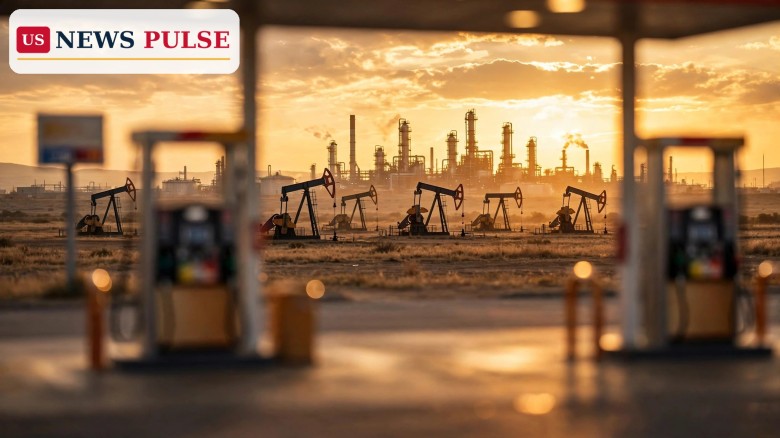
Donald Trump's oil and gas holdings have surged 43% in value during the eight-month war with Iran, according to a report by Democrats on Congress's Joint Economic Committee, raising fresh conflict-of-interest questions just three days before the November 3 midterm elections. The report, obtained by CBS News, estimates that the president's energy investments are now worth between $22.5 million and $81.6 million, up from $12.6 million to $46 million at the end of 2025, while American families have paid an estimated $856 more on average for gasoline since the war began.
The findings land at a politically charged moment. Petrol prices have climbed from $2.87 a gallon in February to $4.29, diesel has jumped from $3.68 to $6.28, and Brent crude has risen from below $75 a barrel to more than $115. The White House has flatly rejected any suggestion of a conflict of interest, insisting the president's portfolio is independently managed and that neither he nor his family directs any trade.
The Democratic report, released on October 26 and reported by CBS News, draws on President Trump's financial disclosures to the Office of Government Ethics. Those disclosures report investments and transactions in value ranges rather than exact amounts, which is why every figure in the report is a range. Using LSEG Data Analytics figures, committee Democrats calculated that the stocks Trump already held at the start of 2026 appreciated by about 43% during the war.
The portfolio includes stakes in ExxonMobil, Chevron, Occidental Petroleum, ConocoPhillips and other major American energy companies. Chevron and ExxonMobil are the two largest holdings: Chevron is valued at up to $23.1 million and ExxonMobil at up to $18.4 million. Their shares have risen nearly 25% and 22% respectively since February 20, as energy stocks have surged during the conflict.
Between March and the end of August, the latest period covered by the available disclosures, Trump's investment accounts purchased between $4.7 million and $17.5 million in oil and gas stocks and sold between $2 million and $5.4 million. More than 94% of the purchases identified for 2026 came after February 28, the date the war began, when the United States and Israel launched a large strike on Iran.
One transaction has drawn particular attention. CBS reported that Trump's investment accounts sold between $500,000 and $1 million in ExxonMobil shares on April 7, the same day he announced a ceasefire with Iran. ExxonMobil shares fell more than 6% at the open the following day. The report does not establish that the president directed that sale, or any individual transaction, and it does not claim he made military decisions to increase his personal wealth.
The war with Iran has now lasted eight months, and its economic footprint is enormous. Pentagon figures reported on October 29 put the estimated US military cost of the war at $47.1 billion through mid-October. At the same time, the committee calculates that American consumers have paid an additional $101 billion for gasoline since the war began on February 28.
Energy stocks have been among the biggest winners of the conflict. The S&P 500 energy sector has gained more than 50% this year, compared with an approximately 11% rise in the broader index. That rally explains much of the rise in the value of the president's holdings, which are a relatively small part of his overall wealth: Forbes estimated his net worth at approximately $7 billion in September.
The disclosure system itself shapes the debate. Because the Office of Government Ethics requires office-holders to report investments in broad value ranges, neither supporters nor critics can pin down an exact figure. The committee's headline number, $81.6 million, is the top of a wide range whose bottom is $22.5 million, and the end-of-2025 range was $12.6 million to $46 million. The 43% figure refers to the appreciation of stocks already held at the start of the year, not to the total change in the portfolio's value including new purchases.
Trump has, at various points, both celebrated the energy industry's gains and blamed Tehran for the pain at the pump. Speaking in Georgia on Saturday, he said American oil and gas companies were "making hundreds of billions of dollars" from the conflict and predicted that fuel prices would fall sharply once the war ended. He added that his advisers had warned him against discussing how much money the industry was making from the turmoil in the Middle East.
The previous week, he accused Iran of deliberately driving up oil prices ahead of the November 3 midterm elections. In a Truth Social post, he claimed Tehran was fabricating reports of attacks and mines to influence energy markets. He has also said the war is "going to be over very soon", while at the same time not ruling out renewed strikes on Iran after the midterms. The US ambassador to the United Nations, Mike Waltz, told the Financial Times that the conflict could continue for another year, though he hoped Iranian leaders would "come to the table" before then.
Strip away the politics, and the report's core claim is a straightforward market story. A president who owns energy stocks has seen those stocks rise sharply during a war that pushed oil prices higher. Gasoline is up about 49% since February, diesel is up about 71%, and Brent crude is up more than 50%. Energy shares, led by the big integrated oil companies, have followed the commodity higher.
What makes the story politically explosive is the combination of ownership and decision-making power. Trump is, as Senator Maggie Hassan put it, "the country's highest-ranking public employee", and he is also the commander-in-chief directing a war that moves the very markets in which he holds investments. Democrats argue that combination alone creates a conflict, whether or not any individual decision was motivated by personal gain. The White House argues the opposite: that the portfolio's independent management removes the conflict entirely, because the president cannot direct, influence or even provide input on trades.
The administration has also taken steps it says are aimed at bringing fuel prices down, including a deal with Russia to purchase Russian diesel fuel and a waiver of sanctions he had just signed into law. On Thursday, the president announced he would invoke the Defense Production Act to spend $150 million to boost gasoline and diesel production. Those measures, the White House says, show a president acting to lower costs for consumers, not to enrich himself.
Senator Maggie Hassan of New Hampshire, the top Democrat on the Joint Economic Committee, was blunt. "Trump's Iran War has forced Americans to pay much more at the pump while Big Oil rakes in profits and the president's own stock wealth in the oil and gas industry continues to balloon," she said. "As Trump, the country's highest-ranking public employee, continues to own and trade stocks in companies that stand to benefit from his decisions, his actions raise major concerns about conflicts of interest."
White House spokesman Davis Ingle rejected that argument in full. He told CBS that Trump's financial portfolio is "independently managed by third-party financial institutions" through automated investment models that track established stock indexes. "Neither President Trump nor any member of his family has any ability to direct, influence, or provide input regarding how the portfolio is invested or when investments are bought or sold," Ingle said. "All investment decisions are made entirely by independent managers. There are no conflicts of interest."
Ingle added: "President Trump only acts in the best interests of the American public, which is why they overwhelmingly reelected him to this office, despite years of lies and false accusations against him and his businesses." Trump himself has predicted that gas prices will "drop through the floor" once the war ends, though the timeline remains uncertain.
The timing is what turns a financial disclosure story into an election story. With three days to go before the midterms, a record 47.9 million Americans have already voted, and Democrats are ahead in House polling while Senate control hinges on toss-up races. Gasoline prices are one of the most visible prices in American life, and $4.29 a gallon is a number every voter understands. A report that ties the president's personal wealth to the same price surge gives Democrats a simple, repeatable line for the final days of the campaign.
It also feeds a broader argument about presidential ethics that has run through Trump's entire time in office: whether a president with vast business interests can be insulated from them by blind management arrangements, or whether the sheer scale of the interests makes insulation impossible in practice. Previous presidents have typically placed assets in a blind trust; Trump has instead relied on independent management of a portfolio he still owns. The dispute over whether that is enough is unlikely to be settled by this report, but the report gives critics their most concrete numbers yet.
For voters, the more immediate question is simpler: will prices fall, and when? Trump says they will drop sharply once the war ends. His own ambassador to the UN has said the war could run for another year. Between those two statements sits the uncertainty that has defined the conflict's economic impact from the start.
The midterm elections on Tuesday, November 3, will determine whether Democrats gain a chamber of Congress and with it subpoena power and committee chairmanships. If they do, expect the Joint Economic Committee's findings to become the basis for hearings and further demands for disclosure. If Republicans hold both chambers, the report is more likely to fade into the partisan background, though the underlying disclosures will continue to be published.
On Iran itself, the post-election period is the key window. Axios reported, citing a US official, that Trump could be more inclined to order a major military operation against Iran if Republicans suffer heavy losses in the midterms, though a White House official told the outlet that election results would not influence his decisions on Iran. The Wall Street Journal reported that US Central Command chief Admiral Brad Cooper visited the White House on Thursday with Defence Secretary Pete Hegseth and Joint Chiefs chairman General Dan Caine to brief Trump on military options. Any resumption of large-scale operations would be expected to move oil prices again, in either direction depending on the outcome.
Meanwhile, the next round of financial disclosures will show whether the pattern of energy purchases continued beyond August, and whether the April 7 ExxonMobil sale was an isolated trade or part of a broader pattern. Those filings, when they appear, will be the next hard evidence in a debate that currently rests on ranges, estimates and competing interpretations of the same numbers.
How much are Trump's oil and gas holdings worth? Between $22.5 million and $81.6 million, according to Democrats on the Joint Economic Committee, up from $12.6 million to $46 million at the end of 2025. The figures are ranges because ethics disclosures report values in bands, not exact amounts.
What does the 43% figure mean? It is the average appreciation of the energy stocks Trump already held at the start of 2026, calculated from LSEG Data Analytics figures. It is not the same as the change in the portfolio's total value, which also reflects new purchases.
Did Trump personally buy the stocks during the war? His investment accounts bought $4.7 million to $17.5 million in oil and gas stocks between March and August, with more than 94% of 2026 purchases after February 28. The report does not establish that he directed individual trades; the White House says independent managers make all decisions.
How much more are Americans paying for gasoline? The committee estimates families have paid $856 more on average since the war began, and $101 billion extra in total. The national average price rose from $2.87 a gallon in February to $4.29, while diesel rose from $3.68 to $6.28.
What does the White House say? Spokesman Davis Ingle says the portfolio is independently managed through automated models tracking stock indexes, that neither Trump nor his family can direct trades, and that there are no conflicts of interest.
Related coverage on US News Pulse: Trump's 250-foot arch faces a judge's test over its national-security claim, Judge orders Trump ads pulled from TV and social media before the midterms, and US-Iran strike plans: forces ready within 96 hours of a Trump order, reports say.
Leave a Comment



 | Today's Date: