


 | Today's Date:


Trump Reflecting Pool Closing Speech Opens With Pool Talk on Midterm Eve
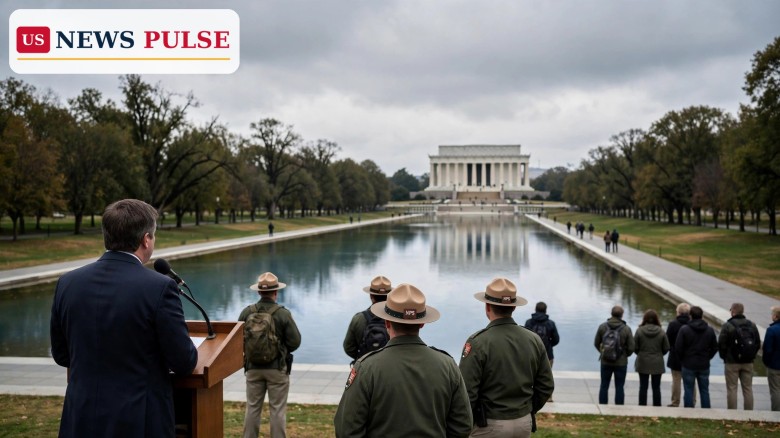
President Donald Trump delivered his closing argument before Tuesday's midterm elections on Monday, November 2, 2026, at the Lincoln Memorial Reflecting Pool in Washington, DC — and spent the opening stretch of the speech talking about the pool itself. In an election dominated by the economy and voters' pocketbook concerns, Trump devoted more than 15 minutes at the start of his final address to the renovation of the landmark, joking that he might rename it after himself, showing before-and-after photographs, and declaring the water feature more beautiful than ever, before turning to his broader pitch to keep Republicans in control of Congress.
Key Points
- Trump spoke at 2 p.m. ET on Monday, November 2, at the Lincoln Memorial Reflecting Pool, the speech the White House billed as his closing argument before the November 3 midterms.
- He opened with more than 15 minutes on the Reflecting Pool renovation, saying the granite had been resurfaced and the pool was now better and more beautiful than ever before.
- He joked about renaming it the Trump Reflecting Pool, saying Secretary Doug Burgum would have fun announcing it, then added: I'm only kidding. Please don't report it.
- Later in the speech he called Alaska's Senate race a fraudulent election, alleging Democrats conspired to put a fake Dan Sullivan on the ballot to confuse voters.
- The speech capped a blitz of more than 25 rallies in a month, with Democrats expected to take the House and with a real shot at the Senate, according to pre-election polling.
What Happened
The stage was set at the edge of the pool, near the base of the steps leading up to the Lincoln Memorial, under a cloudy sky. A small platform stood at the water's edge, with a poster board behind the podium carrying an aerial image of the Reflecting Pool and the words Back, and more beautiful than ever! Signs on either side of the podium read Restoring our Capitol, with The Reflecting Pool underneath in smaller letters. A small number of seats were set out for guests, including uniformed National Park Service workers, and media gathered ahead of the 2 p.m. address.
Trump began, as USA TODAY's live coverage recorded, by joking that he was renaming the pool. We'll announce that some time tomorrow, he said. I'm sure that Secretary Doug Burgum will have a lot of fun in announcing that. Now I'm only kidding. I'm only kidding. Please don't report it. The joke set the tone for an opening that lingered on the project itself rather than on the races on the ballot the next day.
And by the way, we resurfaced the granite. This granite was all resurfaced, Trump said, as he walked the audience through before-and-after photographs of the pool. The pool is now better and more beautiful than it's ever been before, he added. It was, by the live coverage's account, a curious choice for a closing argument in a campaign in which Democrats have accused him of caring more about his Washington building projects — including the White House ballroom and a helipad — than about Americans' affordability concerns.
The White House had described the address in advance as Trump's closing message before the midterms, in which he would highlight his administration's accomplishments and the record of congressional Republicans, and discuss his efforts in the capital, including restoring our Great Capital. In the event, the renovation became the opening act, and the political argument followed it.
Background: How a Quick Fix Became a Political Problem
Trump's involvement with the Reflecting Pool began in April 2026, when he announced a quick fix for about 1.5 million dollars and promised contractors would repair it within days, ahead of Independence Day. The work finished nearly three months behind schedule, and the cost rose to more than 10 times the initial estimate, with federal contracts reported at more than 16 million dollars.
After Trump declared the renovation complete in June, the pool developed algae blooms and sections of its new lining began to peel. Trump blamed vandals, saying the lining had been slashed and that the pool was vandalized badly, and said security cameras had since been installed. Washington's top federal prosecutor, however, said the damage was the result of a botched installation, and the National Park Service announced last month that the pool would remain closed to visitors until November 20 amid ongoing restoration work.
That history is why the choice of venue drew so much attention. The pool, first built in the 1920s, had not worked properly for years, Trump has said, claiming it has always leaked terribly. Critics, including Republican strategist John Feehery, argued the optics were poor on the eve of an election fought over prices. It's better staying on message than talking about ballrooms, arches and reflecting pools, Feehery said. It's very important for him to drive up the Trump base. The problem for the Trump base is that a lot of those folks don't really vote in midterms.
Trump chose the site himself. Speaking to reporters after arriving in Iowa aboard Air Force One on Sunday, he said an appearance at the pool would show how beautiful it is. Hours later, the White House formally announced the Monday afternoon speech, a departure from a month of rallies held largely in conservative territory, from Texas and Kansas to Iowa over the final weekend.
Trump Reflecting Pool Closing Speech and the Alaska Fraud Claim
Beyond the pool, Trump returned to one of his sharpest election claims of the final days: that the Senate race in Alaska is fraudulent. In Alaska, the Dumbocrats conspired to get a fake Dan Sullivan on the ballot to confuse voters, he said, according to Al Jazeera's live coverage of the speech.
The claim concerns two candidates named Dan Sullivan on Alaska's ballot: the Republican incumbent, Senator Daniel S. Sullivan, and retired school teacher Daniel J. Sullivan. The Trump administration has stepped up investigations into allegations that Democrats recruited the teacher as a spoiler candidate to divert votes from the incumbent. Democratic former Representative Mary Peltola, the party's Senate candidate, has denied the allegation.
A federal judge threw out a Trump administration lawsuit in the Alaska race, which had sought to block certification of the election if the incumbent lost by the number of votes the other Sullivan received. The Justice Department is appealing that dismissal. Trump had already raised the dispute on November 1, calling it voter fraud at the highest level and saying Peltola should be prosecuted and removed from the ballot.
Election law experts cited by USA TODAY have said Alaska's ranked-choice voting system lessens the chance that two candidates with the same name will change the outcome, because voters rank candidates in order of preference rather than casting a single vote that can be split. That context did not feature in Trump's remarks, which presented the ballot as a deliberate confusion tactic.
The Alaska claim fits a pattern of election-eve warnings from the president. On the same day, his administration asked the Supreme Court to direct California to set aside mailed ballots cast by anyone on a list of 20,000 registered voters it alleges may not be citizens, a request already covered in US News Pulse's election-eve reporting. Trump has also urged voters to treat Tuesday's election as a referendum on his presidency, while telling supporters on Sunday: We're going to win.
Reactions and Quotes
Democrats spent Monday making their own final arguments, with get-out-the-vote rallies headlined by star Senate candidates James Talarico in Texas and Adam Hamilton in Kansas. In Michigan, Abdul El-Sayed, campaigning in Ypsilanti alongside fellow Democrat Debbie Dingell and Massachusetts Senator Elizabeth Warren, told voters nervous after former primary rival Haley Stevens endorsed his Republican opponent, Mike Rogers, simply to go vote. El-Sayed's campaign had raised 2.4 million dollars in a single day after the Stevens endorsement, its biggest fundraising day yet.
Republicans, meanwhile, were warning their own voters not to stay home. Senator Ted Cruz told supporters at a rally about 40 miles north of Houston on Monday that nearly three-quarters of the most loyal Democrats had already voted, but less than half of loyal Republicans had, and that if the election were over today, the Democrats could well win every single statewide position in Texas. It's real simple math, Cruz said. If our people show up tomorrow, we win. That's it. We've got the numbers.
The broader polling picture explains the urgency on both sides. An NBC News poll released on Sunday showed 60 percent disapproving of Trump's performance, particularly over high prices exacerbated by his eight-month war with Iran. The final New York Times/Siena poll released Sunday evening showed Democratic candidates leading in all seven seats viewed as most competitive, though five remained within the margin of error. Polls have shown Democrats near certain to take the House majority, with a real shot at the Senate.
Democrats have argued that even winning just the House would give them power over the federal budget and control of powerful committees able to investigate alleged corruption under Trump, the Epstein files and other issues. Trump, in a New York Post podcast interview released Monday, said that if Democrats take Congress he would become Mr. Veto, and that he would consider preemptive pardons for Elon Musk and White House aides to protect them from Democratic investigations.
Why It Matters
Tuesday's elections will decide who controls Congress for Trump's final two years in office, and with it the fate of his political agenda. A Democratic House would constrain that agenda, force negotiations over spending, and open investigations the White House has so far been able to resist. A Republican hold would preserve the narrow majorities — 218-214 in the House and 53-47 in the Senate — that have carried his programme, and would keep alive promises such as 5,000-dollar payments to Americans if Republicans retain control.
The speech matters for a second reason: it showed, in public and on the eve of voting, what Trump himself chose to emphasise. In an election his opponents have framed around affordability — gas, groceries, heating oil in Maine, where the Iran war has pushed up costs — the president opened his closing argument with granite, water and a renovation. Supporters will read that as a showcase of delivery, a finished project he can point to. Critics will read it as a symbol of misplaced priorities, and the live coverage's verdict — a curious choice — is likely to be quoted back at him whatever the result.
The Alaska claim matters too, because it plants a dispute over the legitimacy of a Senate race before a single ballot has been counted in it. If the Alaska result is close, the fraud allegation, the dismissed lawsuit and the pending appeal give both sides a ready-made argument about what happened, and election officials a litigation fight to manage while results are certified.
What Happens Next
Voting takes place on Tuesday, November 3, 2026. All 435 House seats and 35 Senate seats are on the ballot, along with state and local races and ballot measures across the country. Early voting has already seen a record 54 million people cast ballots nationwide, and about 11 billion dollars has been spent on advertising in the midterm cycle, with large sums from individual mega-donors.
More than 1,000 federal election monitors are expected at polling places across all 50 states, under a dramatically expanded Justice Department programme. Voting rights groups, including the NAACP, have sued to block the use of federal law enforcement agents as monitors, arguing the deployment could intimidate voters; the Justice Department says its observers are trained personnel who will monitor, document and report on compliance with federal voting laws, not intervene.
Results in the closest Senate races — including Texas, Kansas, Michigan and Alaska — may not be clear on election night, and ranked-choice tabulation in Alaska and Maine can extend the count. The Supreme Court's response to the California ballot request, and any ruling from Judge Reggie Walton on the NAACP monitors case, could also land during the count. US News Pulse will follow the results, the counts and the court fights as they develop.
Frequently Asked Questions
What was Trump's Reflecting Pool closing speech?
It was his final set-piece address before the November 3, 2026 midterms, delivered at 2 p.m. ET on Monday, November 2, at the Lincoln Memorial Reflecting Pool in Washington, DC, billed by the White House as his closing argument.
Why did Trump talk about the pool for so long?
He chose the renovated pool as the venue to showcase a project he ordered, spending more than 15 minutes on the resurfaced granite and before-and-after photographs, and saying the pool was now better and more beautiful than ever before.
Did Trump really propose renaming the pool after himself?
He joked about it, saying an announcement might come the next day and that Interior Secretary Doug Burgum would have fun announcing it, then immediately added: I'm only kidding. Please don't report it.
What did Trump say about Alaska?
He called the Senate race a fraudulent election and alleged Democrats conspired to get a fake Dan Sullivan on the ballot to confuse voters. A federal judge dismissed the administration's lawsuit over the ballot, and the Justice Department is appealing.
What happens on Election Day?
Voters decide control of the House and Senate on Tuesday, November 3, 2026. A record 54 million people had already voted early, and results in the closest Senate races may take days to finalise.
Related coverage: Trump says he will become Mr. Veto if Democrats win Congress, Trump takes California ballot fight to Supreme Court on election eve, and El-Sayed raises $2.4 million in one day after Stevens backs Rogers.
Leave a Comment