


 | Today's Date:



DeSantis Declares Florida Flooding State of Emergency in 7 Counties
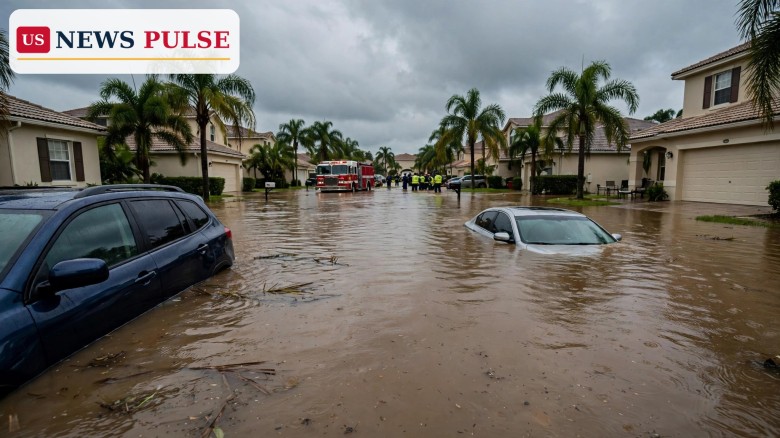
Florida Governor Ron DeSantis declared a state of emergency for seven Florida counties on Monday, November 2, 2026, as record rainfall swamped the state's Atlantic coast, with gauges in southern Brevard County showing between 16 and 22 inches of rain and the National Weather Service warning of extremely dangerous and life-threatening conditions. The declaration, reported by FOX 35 at about 4:57 p.m. Eastern time, covers Brevard, DeSoto, Hardee, Highlands, Indian River, Martin and St. Lucie counties, the counties hit hardest by a stalled weather system that dumped a month's worth of rain in a single day and left whole neighbourhoods under water on the eve of Election Day.
The order came roughly nine hours after the National Weather Service in Melbourne issued its most severe flood alert, a Flash Flood Emergency, for West Melbourne and Palm Bay on Monday morning, later adding Grant-Valkaria. By Monday afternoon, 34 counties across Florida were under flood watches or warnings, schools across the Space Coast were closed for Tuesday, and emergency officials were assessing polling places to make sure they could still open for Tuesday's midterm elections. No flood deaths had been reported as of Monday afternoon, and no evacuation orders had been issued, but officials urged residents to stay home, stay off flooded roads, and reserve 911 calls for people who were trapped and needed rescue.
Key Points
- Governor Ron DeSantis declared a state of emergency on Monday, November 2, 2026, for seven counties: Brevard, DeSoto, Hardee, Highlands, Indian River, Martin and St. Lucie.
- Southern Brevard County recorded 16 to 22 inches of rain by Monday afternoon, with radar estimates of 18 to 20 inches in 12 hours south of Palm Bay described as a 1,000-year rainfall event.
- All Brevard Public Schools campuses and offices, Florida Tech, Eastern Florida State College and Diocese of Orlando schools in Brevard will stay closed on Tuesday, November 3, with DeSoto County schools closed Tuesday and Wednesday.
- Palm Beach County was not included in the governor's order, even though it declared its own local emergency and its county administrator said it was seeking an executive order from DeSantis.
- Election officials said polling locations were being assessed for flood damage and were expected to remain open on Tuesday, despite school and road closures across the region.
What Happened
The rain began over the weekend, when a stalled low-pressure system pulled deep tropical moisture over Florida's Atlantic coast. It was not a tropical storm or a depression: the National Hurricane Center listed no Atlantic cyclones on Monday. But the system barely moved, and the rain kept falling on ground that was already saturated, overwhelming drainage systems, swelling canals, and turning streets into rivers from Cape Canaveral to Melbourne and south toward Port St. Lucie and Fort Pierce.
The National Weather Service in Melbourne put south Brevard under a flood watch starting at 10 a.m. on Sunday, then escalated to a Flash Flood Emergency on Monday morning as the rain intensified. By 3:36 p.m. on Monday, weather service gauges showed 16 to 22 inches of rain in southern Brevard. Fox Weather reported radar estimates of 18 to 20 inches in 12 hours just south of Palm Bay, a total that would make it a 1,000-year event, beyond the National Oceanic and Atmospheric Administration's 15.5-inch threshold for such an event in the area. In southeastern Palm Bay, Grant-Valkaria and parts of Malabar, about 20 inches fell over 24 hours. Melbourne's airport recorded 13 inches across Sunday and Monday by mid-afternoon, preliminarily the wettest day on record there, beating Hurricane Irma.
The flooding hit roads, homes and infrastructure across the Space Coast, a 72-mile stretch from Mims to Sebastian that includes Cape Canaveral Space Force Station and NASA's Kennedy Space Center. Part of Port Malabar Road washed out, a water main broke in Palm Bay, and the city said a boil-water notice would follow once service returned. Kennedy Space Center advised staff to work from home because of roadway flooding. Health First physician offices and laboratories closed for the day, as did many restaurants and shops. In Palm Bay, the city told residents to shelter in place as water rose around stalled cars and into homes, and emergency officials warned that the wake from a vehicle driving through floodwater could push water into houses.
As the day wore on, the emergency was downgraded in Brevard from a Flash Flood Emergency to a flash flood warning, but the danger did not end. Flood warnings remained in place for Florida's east coast, including Port St. Lucie and Fort Pierce, where up to 8 inches had fallen. A portion of east-central Florida, including Indian River, Martin, St. Lucie, Volusia, Okeechobee and Brevard counties, remained under a flood watch through the morning of Tuesday, November 3, with another 1 to 2 inches of rain expected before skies were forecast to clear midweek. Forecasters said a further 1 to 3 inches could fall on Monday night, with drier weather expected by Thursday.
Background and Context
Brevard County has flooded before, but residents and forecasters alike described Monday's rain as exceptional. Some residents compared the steady, persistent downpour to Tropical Storm Fay in 2008, which dropped 27.65 inches as it stalled over Central Florida and ranks as the fifth wettest tropical storm to affect the state. Monday's storm was different in kind: no tropical cyclone, no named storm, just a stalled front drawing tropical moisture over the same coastal counties for hours on end. That persistence is what turned a heavy-rain event into a record one, with totals climbing through the morning as each new band of rain fell on ground that could absorb no more.
The flooding also arrived at the worst possible moment in the political calendar. Tuesday, November 3, is Election Day in the 2026 midterms, when all 435 House seats, 35 Senate seats and governor's races in 36 states are on the ballot. Brevard County's Supervisor of Elections office in Viera stayed open on Monday for voters, and emergency officials said they were assessing schools and election precincts for flood damage. Sheriff Wayne Ivey said at a Monday afternoon Brevard County Emergency Management news conference that polling locations were expected to remain open on Tuesday, even as schools and county facilities closed. The assessment mattered because many polling places are schools, and every Brevard public school campus was shut for the day.
The state emergency declaration itself followed a day in which local governments had already acted on their own. Riviera Beach declared a local state of emergency unanimously on Monday. Indian River and St. Lucie counties declared local emergencies on Monday afternoon. Palm Beach County declared a local emergency and, according to its county administrator, Joseph Abruzzo, was seeking an executive order from the governor. That request, tied in part to the separate Greenacres Learjet crash disaster in Palm Beach County, was still outstanding when the governor's seven-county order was reported. Palm Beach County was not among the seven counties named.
Florida Flooding State of Emergency: What the Declaration Does
A state of emergency declaration puts Florida's state agencies on an emergency footing. It allows the Division of Emergency Management to coordinate the state response, move resources such as generators, fuel, flood barriers, bottled water, shelf-stable meals, tarps and sandbags toward the affected counties, and seek federal help if the damage warrants it. It also gives state and local personnel flexibility they do not have in normal operations, including the ability to waive certain rules so that crews, equipment and supplies can move faster. For counties named in the order, it opens the door to state assistance with the costs of response and recovery, from debris clearance to repairs for damaged public infrastructure.
The timing of the order drew scrutiny on Monday evening. A local outlet noted that, as of its publication time, the order had not yet appeared on the governor's website, the governor had made no public remarks about the flooding, and no other state action had been announced, even though the Flash Flood Emergency had been issued about nine hours earlier. The governor had been in Palm Beach County on Sunday for the response to the Learjet crash that killed nine people near Greenacres. The seven-county order, first reported by FOX 35, was the first statewide action of the flooding emergency, and it left Palm Beach County, which had asked for its own executive order, outside its scope for the time being.
Whether the order is extended to more counties will depend on how the water moves overnight. Floodwaters in Brevard were expected to recede as the storm tapered off on Monday evening, according to John Scott, executive director of the Brevard Emergency Operations Center, who said sections of south Brevard had received 15 to 20 inches of rain. But rivers and canals stay high after the rain stops, and the St. Johns River near DeLand was already at a 4-foot flood stage on Monday, with a crest of 4.1 feet expected on Monday evening. Damage assessments, which will determine the scale of state and federal help, cannot be completed until the water falls and crews can reach every affected street.
Reactions and Quotes
Brevard County emergency officials used their Monday afternoon news conference to deliver a blunt safety message. Sheriff Wayne Ivey urged residents to stay home and off the roads, a message summed up in the advice: if you can, stay put. Officials said 911 calls should be reserved for people who were trapped and needed assistance, rather than for reporting flood damage, so that dispatchers and rescue crews could reach those in immediate danger first.
John Scott, the county's emergency operations director, said Brevard had been hit hardest in the south end of the county, where rainfall totals were highest and the Flash Flood Emergency had been in force the longest. The National Weather Service's warnings used the strongest language in its vocabulary for flooding, cautioning residents about extremely dangerous and life-threatening conditions and urging people in the emergency area to seek higher ground immediately and never to drive through flooded roads.
School leaders, meanwhile, moved quickly to extend closures beyond Monday. Brevard Public Schools said all campuses and offices would close on Tuesday, November 3, as the district continued to assess flooding and building safety, with schools expected to resume on Wednesday. Florida Tech announced that all classes and campus activities were cancelled on Tuesday as the university continued to clear flood debris. Eastern Florida State College said it would remain closed on Tuesday across its four campuses, and the Diocese of Orlando said all of its Brevard schools would be closed on Tuesday. DeSoto County went further, announcing closures for both Tuesday and Wednesday, while Hardee County schools were closed on Tuesday.
Why It Matters
The declaration matters for three reasons. First, it is a recognition of scale: 22 inches of rain in a day is not a routine Florida downpour, and a 1,000-year rainfall figure, if confirmed, would place Monday among the most extreme rain events ever recorded on the Space Coast. Second, it unlocks the machinery of state response at a moment when local crews are stretched across seven counties at once, with roads washed out, a water main broken, and damage reports still coming in. Third, it lands on the eve of an election, when the ability of voters to reach the polls, and of election workers to staff them, depends on roads that are currently under water.
The Palm Beach exclusion matters too, because it shows the limits of a county-by-county order in a storm that does not respect county lines. Palm Beach County is dealing with two disasters at once: the flooding and the aftermath of Sunday's Learjet crash, which displaced hundreds of mobile home residents and closed a stretch of Military Trail. Its request for a state emergency order for the crash area was already pending before the flooding began. Whether the governor extends Monday's order, or issues a separate one, will shape how quickly state help reaches the county's displaced residents and its flooded neighbourhoods.
For Florida more broadly, Monday was a reminder that the state's flood risk is not confined to hurricane season or to named storms. A stalled front, deep tropical moisture and saturated ground were enough to produce record rain, a flash flood emergency, and a multi-county state of emergency, all without a cyclone anywhere in the Atlantic. As the climate warms, forecasters warn that storms can hold more moisture and drop it faster, which is why totals that once seemed unthinkable, like 20 inches in a day over a single county, are now appearing in the record books.
What Happens Next
Overnight, the rain is expected to ease, with 1 to 3 more inches possible before drier air arrives midweek. Flood watches for east-central Florida run through the morning of Tuesday, November 3, and floodwaters are expected to recede through Monday evening and into Tuesday, though rivers and canals will stay high. Damage assessment teams will begin surveying homes, roads and public buildings once the water falls, and school districts will decide on Wednesday reopening based on building safety checks and road access.
On Tuesday, the focus will shift to the polls. Election officials will confirm which polling places are open, whether any have moved, and how voters in flooded neighbourhoods can reach them. Brevard's schools are expected to resume on Wednesday, and colleges will reassess after Tuesday's closures. If the damage totals warrant it, the governor could extend the emergency to additional counties, including Palm Beach, or the state could seek a federal disaster declaration. US News Pulse will follow the receding water, the damage assessments, the school reopening decisions, and any extension of the emergency order as those developments are confirmed.
Frequently Asked Questions
Which counties are covered by the Florida flooding state of emergency?
The governor's order covers seven counties: Brevard, DeSoto, Hardee, Highlands, Indian River, Martin and St. Lucie. Palm Beach County was not included, despite declaring its own local emergency and seeking a state executive order.
How much rain fell in Brevard County?
Gauges in southern Brevard showed 16 to 22 inches of rain by Monday afternoon, with about 20 inches over 24 hours in southeastern Palm Bay, Grant-Valkaria and parts of Malabar. Radar estimates of 18 to 20 inches in 12 hours south of Palm Bay would make it a 1,000-year rainfall event.
Are Brevard schools closed on Tuesday, November 3?
Yes. All Brevard Public Schools campuses and offices, Florida Tech, Eastern Florida State College and Diocese of Orlando schools in Brevard are closed on Tuesday, November 3. Brevard schools are expected to resume on Wednesday. DeSoto County schools are closed Tuesday and Wednesday.
Will polling places be open on Election Day?
Election officials said polling locations were being assessed for flood damage and were expected to remain open on Tuesday, November 3. Voters should check with their local supervisor of elections for any changes to their polling place.
Was anyone killed in the Florida flooding?
No flood deaths had been reported as of Monday afternoon, and no evacuation orders had been issued. Officials urged residents to stay home, avoid flooded roads, and call 911 only if trapped and in need of rescue.
Related coverage: Flash flood emergency as 15 to 20 inches of rain swamp Palm Bay, Florida, Brevard flooding: Florida schools close as 11.9 inches of rain swamp east coast.
Leave a Comment