


 | Today's Date:




Greenacres Learjet Crash: NTSB Probes Icing After 27,000-Foot Plunge Monday
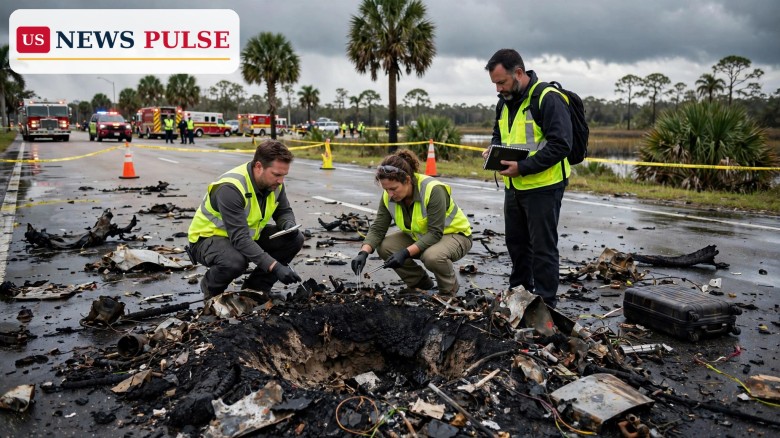
Federal investigators fanned out across a shattered stretch of Military Trail in Greenacres on Monday morning, beginning the painstaking work of explaining how a Learjet 60 carrying nine people fell out of the sky in less than a minute on Sunday. The National Transportation Safety Board's go-team arrived at the Palm Beach County crash site as chilling air-traffic recordings emerged, capturing a pilot who first reported ice building on the aircraft and then, moments later, shouted a mayday as the jet plunged 27,000 feet in a single minute.
All nine people aboard the business jet, which was flying from Austin, Texas, to the Bahamas, were killed when it slammed into the roadway at about 12:50 p.m. on Sunday, exploding into a fireball and carving a crater into the asphalt. No one on the ground was reported killed or injured, but about 600 residents of a nearby mobile home community were forced from their homes because debris blocked the entrance to their neighbourhood, and they spent Sunday night in county shelters. As of Monday morning, authorities had still not released the names of the nine victims, and the agency said it would hold a news conference in West Palm Beach later on Monday, though it had not yet announced a time or place.
Key Points
- The NTSB go-team began its on-site investigation in Greenacres on Monday, November 2, after the Sunday crash of a Learjet 60 killed all nine people aboard.
- Cockpit radio recordings capture the pilot reporting ice accumulation and moderate turbulence, then shouting "Mayday, mayday!" as the jet entered an overspeed descent.
- Flight-tracking data shows the aircraft plunged 27,000 feet in one minute — about 450 feet per second — before its signal was cut off.
- Weather is emerging as a major factor: the jet passed through a stronger storm cell minutes before it began falling, and icing can rob a plane of lift and control.
- It is the second-deadliest plane crash in the United States this year and the deadliest ever involving a Learjet 60, according to aviation records.
What Happened
The Learjet 60 had departed Austin-Bergstrom International Airport in Texas and was bound for North Eleuthera Airport in the Bahamas when disaster struck over Palm Beach County on Sunday afternoon. The aircraft came down on Military Trail, a major thoroughfare between Cresthaven Boulevard and 10th Avenue North in Greenacres, a city of about 45,000 people roughly seven miles south-west of West Palm Beach. Video from the scene showed burning wreckage scattered across a crater in the roadway, with flames rising from the impact site and a wide field of debris.
Governor Ron DeSantis, who visited the scene on Sunday, described the crash in stark terms. "It was a cataclysmic plane crash," he said. "It looked like a missile going down." He added that debris was strewn across a wide area and confirmed there had been no reports of anyone on the ground being killed or injured by the falling wreckage, a remarkable outcome given that the jet struck a busy roadway in a residential area.
The final moments of the flight are now documented in air-traffic control recordings captured by LiveATC.net and reported by CNN. In the recordings, the pilot calmly reported ice accumulating on the aircraft, with an outside air temperature of minus 47 degrees Celsius (minus 52 degrees Fahrenheit), along with moderate turbulence that bounced the plane by up to 700 feet. Moments later, the tone changed completely. "Mayday, mayday!" the pilot shouted. "We're descending 10,000 feet per minute!" the pilot told the Miami Air Route Traffic Control Center. Then: "We are in an overspeed condition descending 20,000 feet per minute. We're going to crash into the ground!"
In reality, the descent was even faster than the crew's final estimates. Flight-tracking data published by ADS-B Exchange shows the jet plummeted 27,000 feet in one minute — roughly 450 feet per second — just before its tracking signal was cut off. That rate of descent is far beyond anything seen in a controlled emergency descent, and it has become the central puzzle for investigators: what turned a routine cruise, in which the crew was still communicating calmly about ice and turbulence, into an uncontrolled plunge within seconds?
Background and Context
The aircraft involved was a Learjet 60 manufactured in 2004 and registered as N722BD, according to Flightradar24 data. Federal Aviation Administration records list the jet as registered to a limited liability company in Delaware and available for charter online. The FAA has confirmed nine people were aboard; US Transportation Secretary Sean Duffy announced on Sunday that everyone on board had been killed, calling the crash a "horrific tragedy."
Weather conditions at the time were unsettled across South Florida. There were scattered storms in the area on Sunday, with thunderstorms across the peninsula near Lake Okeechobee and winds from the east at 15 mph gusting to as strong as 25 mph, according to the Palm Beach Post's live coverage. The aircraft passed through a stronger storm cell a few minutes before it began descending, though it remains unclear whether that storm cell directly contributed to the crash.
Even in warm climates, thunderstorms generate powerful updrafts — columns of rising air that cool rapidly with altitude. At the altitudes where business jets fly, temperatures inside those updrafts can drop as low as minus 100 degrees Fahrenheit, cold enough for ice to form quickly on wings and other surfaces. Ice changes the shape of a wing, adds weight and drag, and can make it far harder for a pilot to manage the aircraft's flight path and airspeed. In January 2024, the NTSB published a safety alert emphasising the risks of in-flight icing, warning that ice can "make managing the airplane's flightpath and airspeed more difficult and can prevent the airplane from maintaining level flight." Aircraft carry anti-ice systems, but in severe conditions those systems cannot always keep up with the rate at which ice accumulates.
Sunday's crash is already historically significant. According to NTSB records cited by CNN, it is the second-deadliest plane crash in the United States this year, behind only a June crash in Butler, Missouri, in which 12 people died when a skydiving plane went down. It is also the deadliest crash ever involving a Learjet 60, according to data from the Flight Safety Foundation. The previous worst Learjet 60 accident killed four people when a jet bound for Los Angeles crashed on take-off from Columbia, South Carolina, in 2008.
Greenacres Learjet Crash Investigation: What the Go-Team Will Examine
The Greenacres Learjet crash investigation now enters its evidence-gathering phase, and the NTSB's go-team — specialists in structures, powerplants, systems, weather, air traffic control and flight recorders — will work through a long checklist at the scene. Their first tasks are to document the wreckage field, map where each piece of the aircraft came to rest, collect recordings and radar data, and interview witnesses, air-traffic controllers and anyone who saw or heard the jet's final descent.
One of the most important questions is whether the jet's flight data recorder survived. Mary Schiavo, a CNN aviation analyst and former inspector general for the Department of Transportation, warned that the violence of the impact may have destroyed it. The steep descent could have forced parts of the plane to break off in the air, she said, and the flight data recorder could have been destroyed in the explosion that followed impact. It is also not yet clear whether the aircraft carried a cockpit voice recorder; federal rules require jet aircraft with more than one engine to carry a voice recorder if they are flown for hire, and investigators will establish the jet's operating status as part of their work.
Dashcam video from passing vehicles is likely to be another crucial piece of evidence. Cameras on cars travelling along Military Trail may have captured the jet's final seconds, helping investigators reconstruct its attitude, speed and whether parts separated before impact. Witness accounts will also matter: residents near the crash site described hearing and feeling the explosion, losing power instantly, and seeing a large black cloud of smoke rise over the neighbourhood.
Investigators will also examine the aircraft's maintenance history, its engine performance, its flight-control systems and its de-icing equipment, alongside the weather the jet flew through and the crew's communications with air traffic control. The NTSB's final report, which determines probable cause and can issue safety recommendations, typically takes a year or more, though a preliminary report with early factual findings is usually released within weeks. For now, officials have stressed that no cause has been established and that speculation about a single factor — weather, icing, mechanical failure or something else — would be premature.
Reactions and Quotes
Governor DeSantis's description of the crash as "cataclysmic" set the tone for a sombre Sunday evening in Palm Beach County. "There is a lot of debris that was strewn as a result of this crash," he said, while confirming that no one on the ground had been reported killed or injured. County officials moved quickly to shelter the displaced: about 600 people were in need of shelter because damage on the ground blocked the entrance to a mobile home park, said Joel Flores, the Palm Beach County commissioner for District 3, who was the first county official at the scene. Residents were sent to two shelters in the county while the site is investigated, he said.
Residents described a terrifying afternoon. "I heard and felt the boom," Andrew Mannino told CNN. "The power immediately went out and is still out." Mannino said he smelled the smoke and saw a large black cloud in the sky above the crash site.
Aviation experts urged caution about drawing conclusions from the dramatic descent figures alone. "That is not a controlled descent," Schiavo told CNN. "It's clear, whatever happened, they had lost control of the plane." Her assessment points investigators toward the central question of the probe: what robbed the crew of control so suddenly, and whether ice, turbulence, a mechanical failure or a combination of factors was responsible.
The crash also disrupted daily life across the area on Monday. John I. Leonard High School in Greenacres stayed closed for the day as emergency crews continued working at the nearby crash site on Military Trail, while all other Palm Beach County district-operated schools were scheduled to open. Heavy rain into Monday morning threatened to delay buses and slow school car lines, and all district schools are already set to close on Tuesday for Election Day.
Why It Matters
This crash matters beyond its terrible death toll because it sits at the intersection of two recurring aviation safety problems: flying through convective weather and the insidious danger of airframe icing. Business jets routinely fly above most weather, but the climb and descent phases — and any deviation through storm cells — can expose them to icing conditions that develop with frightening speed. The NTSB's own 2024 safety alert shows regulators have been warning about this risk for years, and whatever the Greenacres investigation finds about the performance of this jet's anti-ice systems and the crew's decisions will feed directly into future guidance for pilots and operators.
It also matters for the community it struck. A jet falling onto a busy roadway in a residential area could easily have killed people on the ground; that it did not is, in DeSantis's words, remarkable. But 600 displaced residents, a shattered major road, a closed school and a neighbourhood that heard and felt the explosion are a reminder that an aviation disaster's impact radiates far beyond the aircraft itself. The investigation's findings will shape not only aviation safety but also how local authorities plan for the aftermath of such events.
What Happens Next
The NTSB is expected to hold its first news conference in West Palm Beach on Monday, where investigators may confirm the composition of the go-team, describe what has been recovered so far, and say whether either recorder has been found. The time and location of that briefing had not been announced as of Monday morning, and the victims' names had still not been released, pending notification of families.
In the coming days, investigators will remove the wreckage to a secure facility for detailed examination, while air-traffic recordings, radar tracks and weather data are analysed. A preliminary report is expected within weeks. The full investigation — including a probable-cause determination — will take far longer, and officials have asked the public to avoid speculating until the evidence is assembled. Meanwhile, Military Trail remains disrupted around the crash site, displaced residents wait to learn when they can return home, and a community that watched a jet fall from the sky waits for answers about why nine people never made it to the Bahamas.
Frequently Asked Questions
What happened in the Greenacres Learjet crash?
A Learjet 60 flying from Austin, Texas, to the Bahamas crashed onto Military Trail in Greenacres, Florida, at about 12:50 p.m. on Sunday, November 1, killing all nine people aboard. The jet plunged 27,000 feet in one minute before impact, according to flight-tracking data.
What did the pilot say before the crash?
Air-traffic recordings capture the pilot reporting ice accumulation and moderate turbulence, then shouting "Mayday, mayday!" and reporting descents of 10,000 and then 20,000 feet per minute, saying "We're going to crash into the ground!"
Has the cause of the crash been determined?
No. The NTSB investigation began in earnest on Monday, and officials have said no cause has been established. Weather and icing are emerging as factors under examination, but investigators warn against premature conclusions.
Have the victims been identified?
Not publicly. As of Monday morning, authorities had not released the names of the nine people killed, and no one on the ground was reported killed or injured.
When will the NTSB brief the public?
The NTSB said it would hold a news conference in West Palm Beach on Monday, but the time and location had not been announced as of Monday morning. A preliminary report is usually released within weeks, with a final report taking a year or more.
Related coverage: Greenacres Learjet crash: DeSantis calls it cataclysmic as 600 evacuated, Greenacres plane crash: all 9 aboard Learjet killed, officials confirm, and Florida I-95 crash kills 3 in Martin County, including 5-year-old boy.
Leave a Comment